THALis: seven-population anatomical model
7 populations, signed connections, PT readout. check the stability notation... spectral radius can't be negative, need the largest real part where i'm talking about continuous-time stability
model in the anatomical draft: a two-dimensional cortical sheet with seven population-rate variables per spatial location: IT in layers 2/3 and 5A, PT in 5B, CT in layer 6, and PV, SOM and VIP interneuron populations. The variables are modeled population firing rates, not seven directly recorded EEG signals.
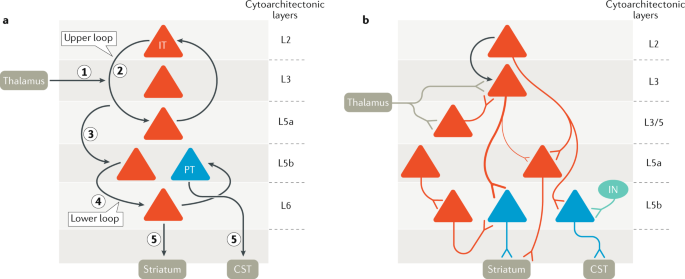
Motor-cortex connectivity diagram
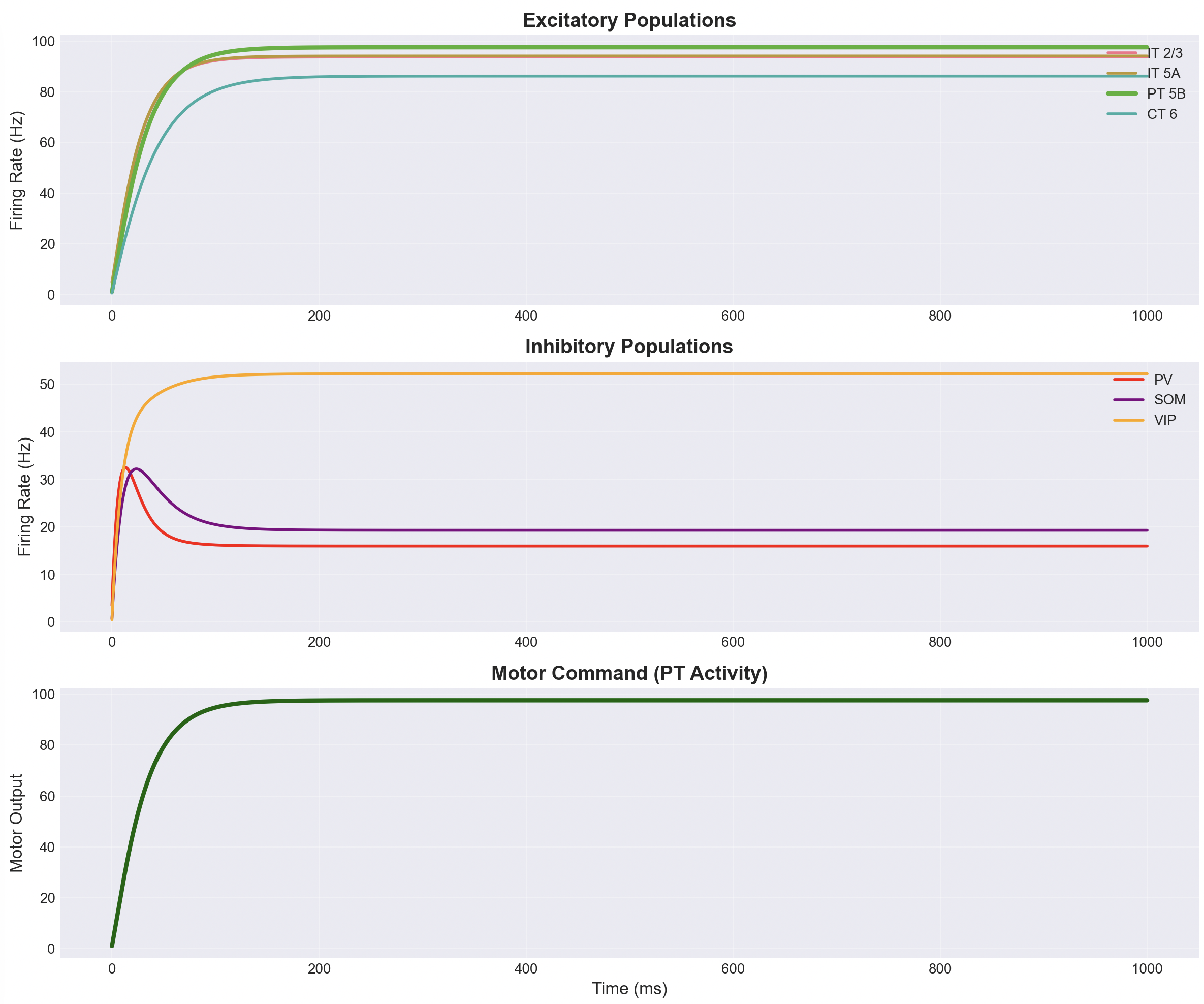
Anatomical-model population trajectories
connectivity notation: W_ij(x,x') = P_ij * S_ij * K_ij(||x-x'||), separating connection probability, strength and spatial kernel. Spatial integration produces the population input. After discretizing into N columns, the written state equation is r_dot = -D^-1*r + D^-1*phi(W*r + I), where D contains the 7N time constants.
- output assumption: the draft maps PT population activity to a muscle-activation vector through a spatial synergy operator
M(x). This is a model assumption to relate neural state to output, not a direct EEG measurement or validated subject-specific map.
- notation issue to resolve: the stability subsection writes
rho(J)<0while using rho elsewhere for spectral radius. A spectral radius cannot be negative. For a continuous-time Jacobian, check whether the intended object is the largest real part of its eigenvalues instead. Do not reproduce the inequality without correcting its meaning and checking the full model assumptions.
- review questions: how are parameters constrained or fitted, what spatial discretization is used, and how are sign conventions enforced across the expanded population equations?
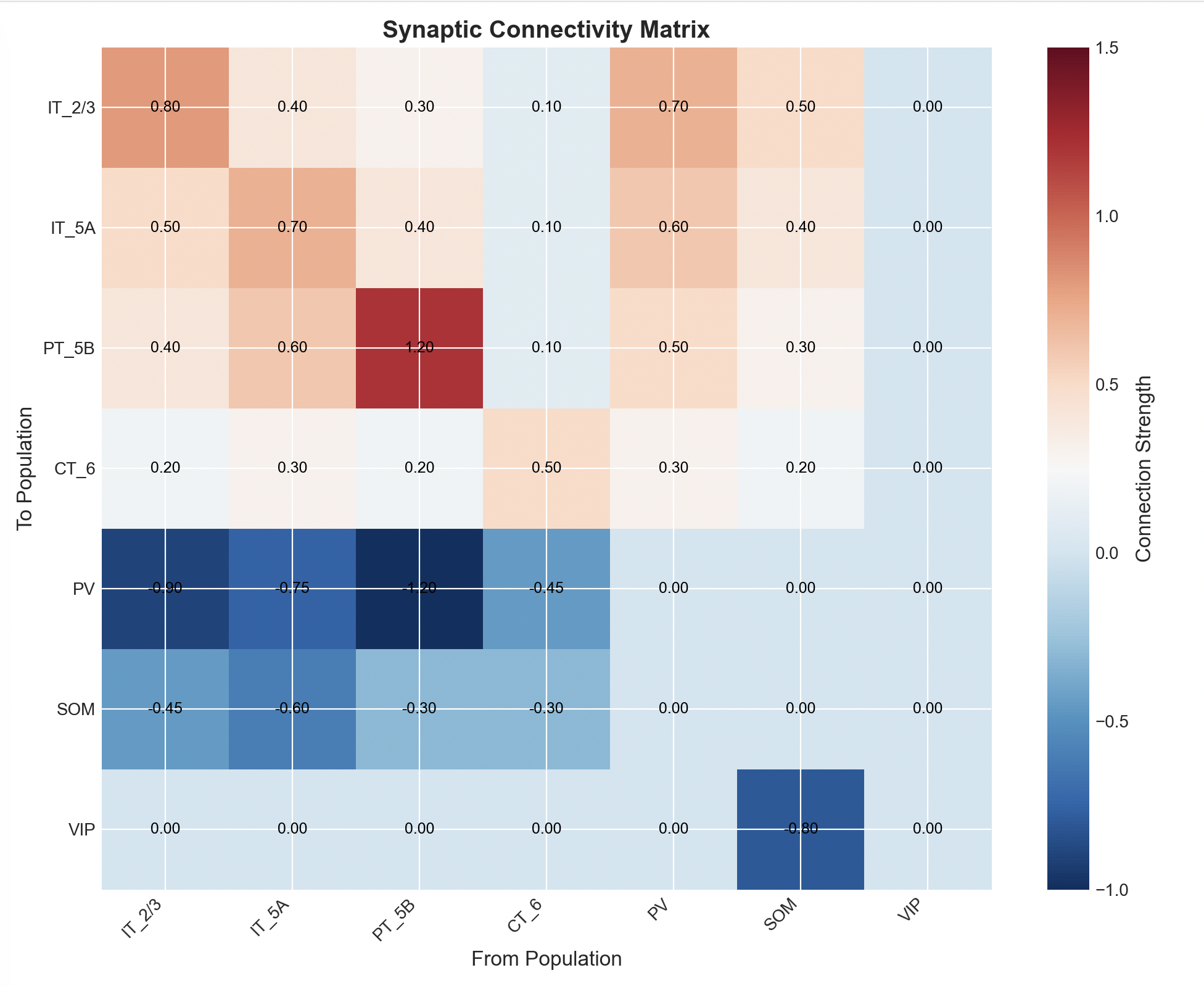
Signed synaptic connectivity matrix
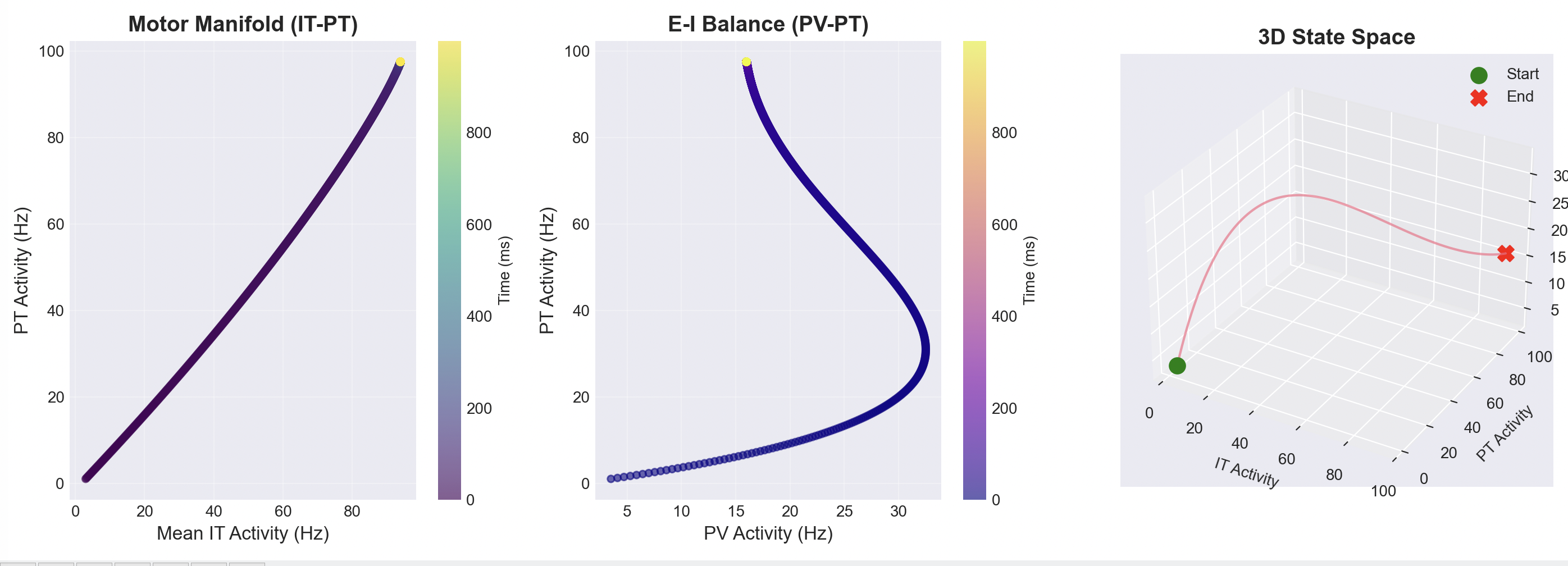
Motor manifold and excitatory–inhibitory balance
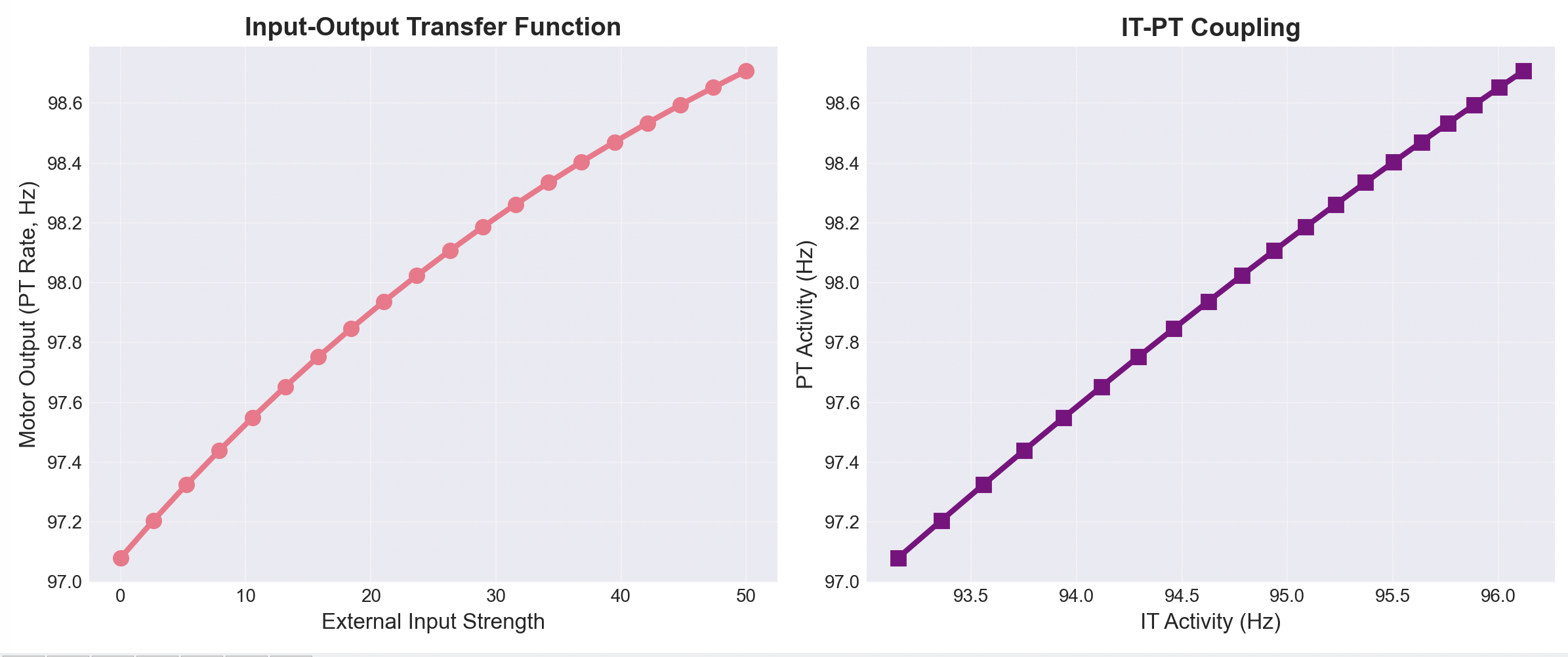
IT/PT coupling and input–output transfer
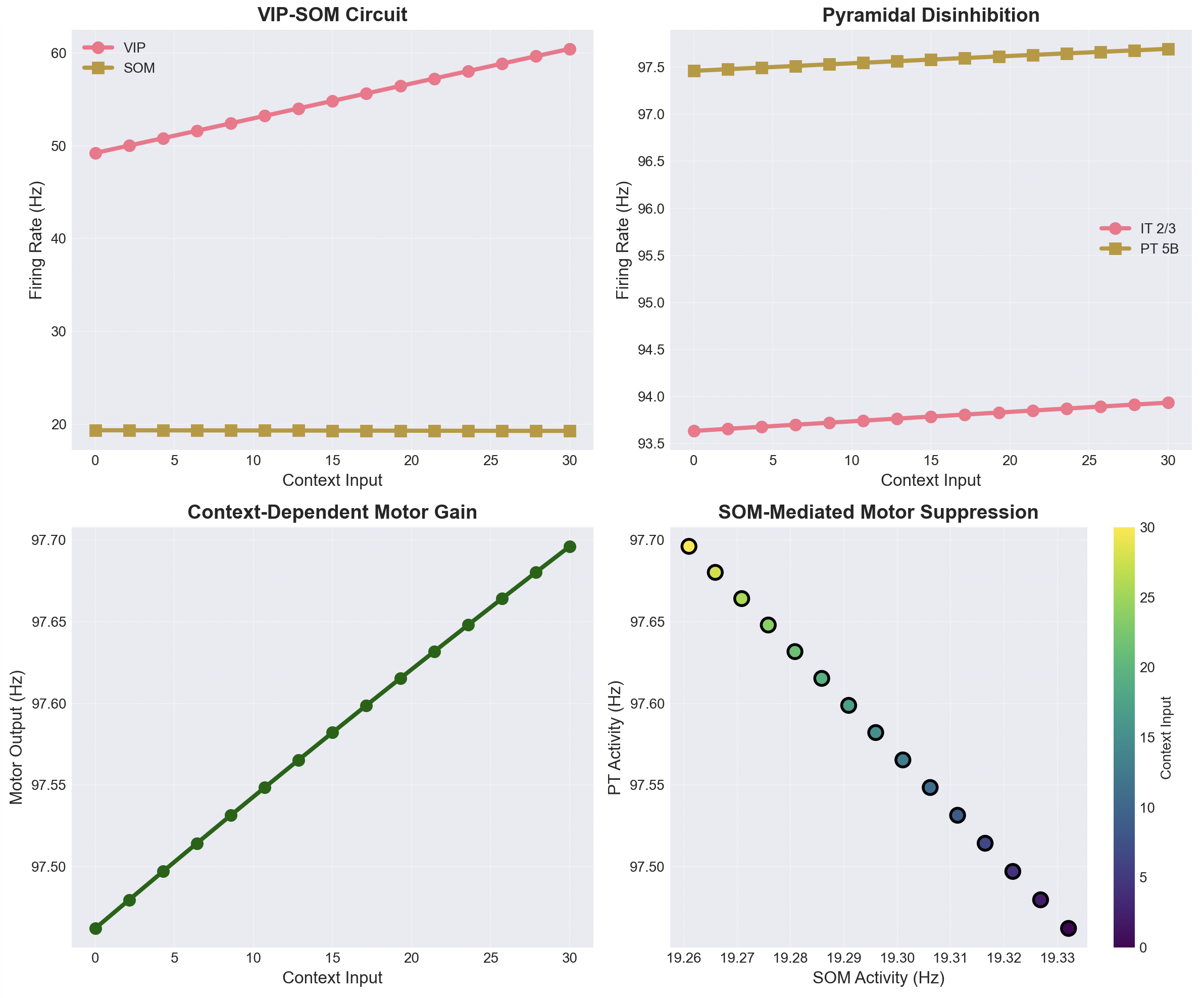
VIP–SOM circuit and motor gain
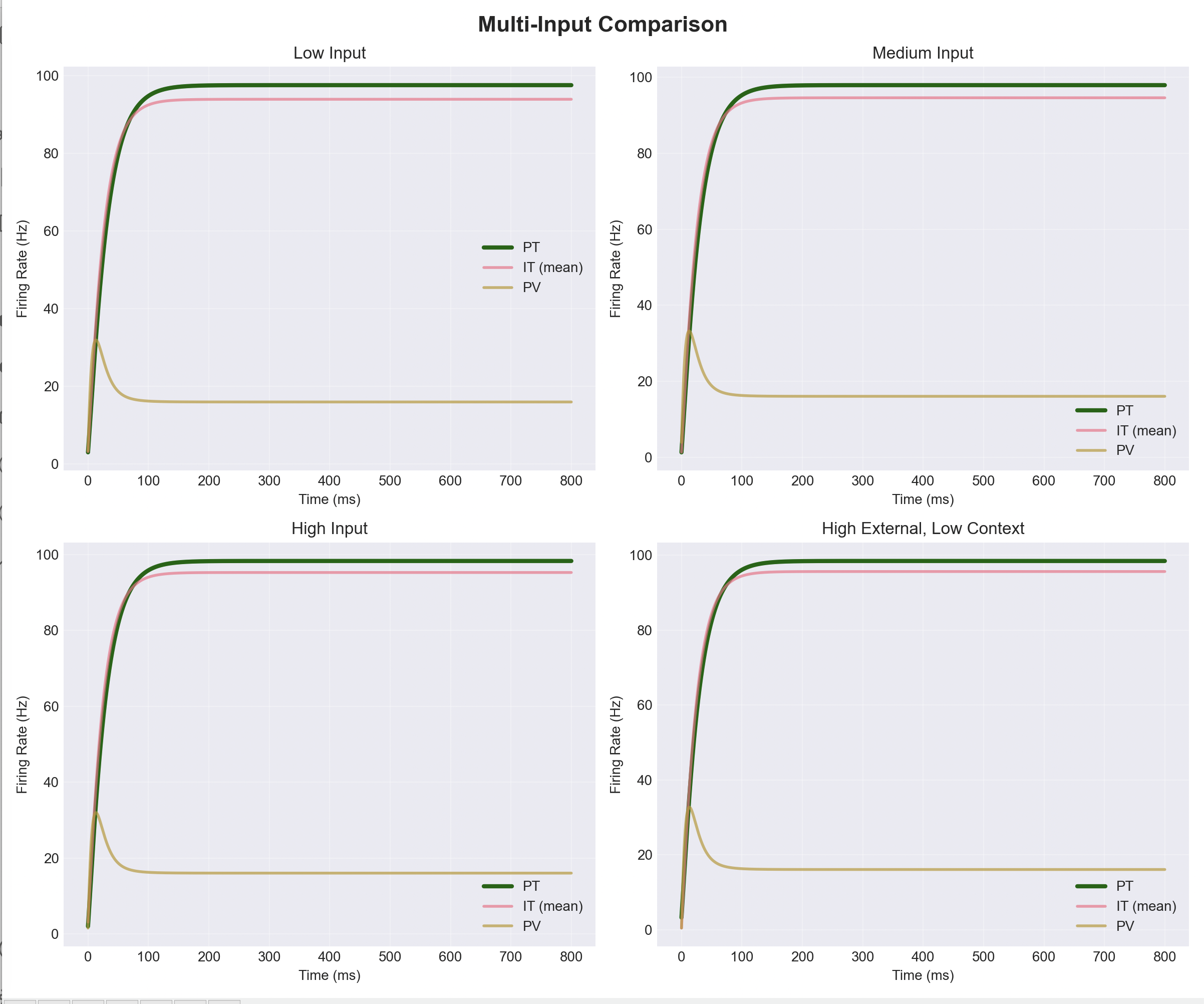
Model responses across input and context settings