THALis: primer-to-code consistency checklist
trace ONE window all the way from filter to hand command. primer and code should agree on the intermediate objects, especially covariance / tangent space / readout
primer architecture: filter EEG, estimate sliding covariance, log-map it to features, update a leaky reservoir, estimate phase/primitive, then map a synergy readout to hand joints. The primer describes 36 upper-triangular features for an eight-channel covariance matrix, CCA for coupling EEG and kinematics, and ridge regression for the readout.
artifact split: distinguish this architecture description from the archived CSP/LDA pipeline. Determine which version actually implements each stage before combining results from the two. The primer also describes offline zero-phase filtering and a real-time IIR approximation; those are not automatically the same preprocessing transform.
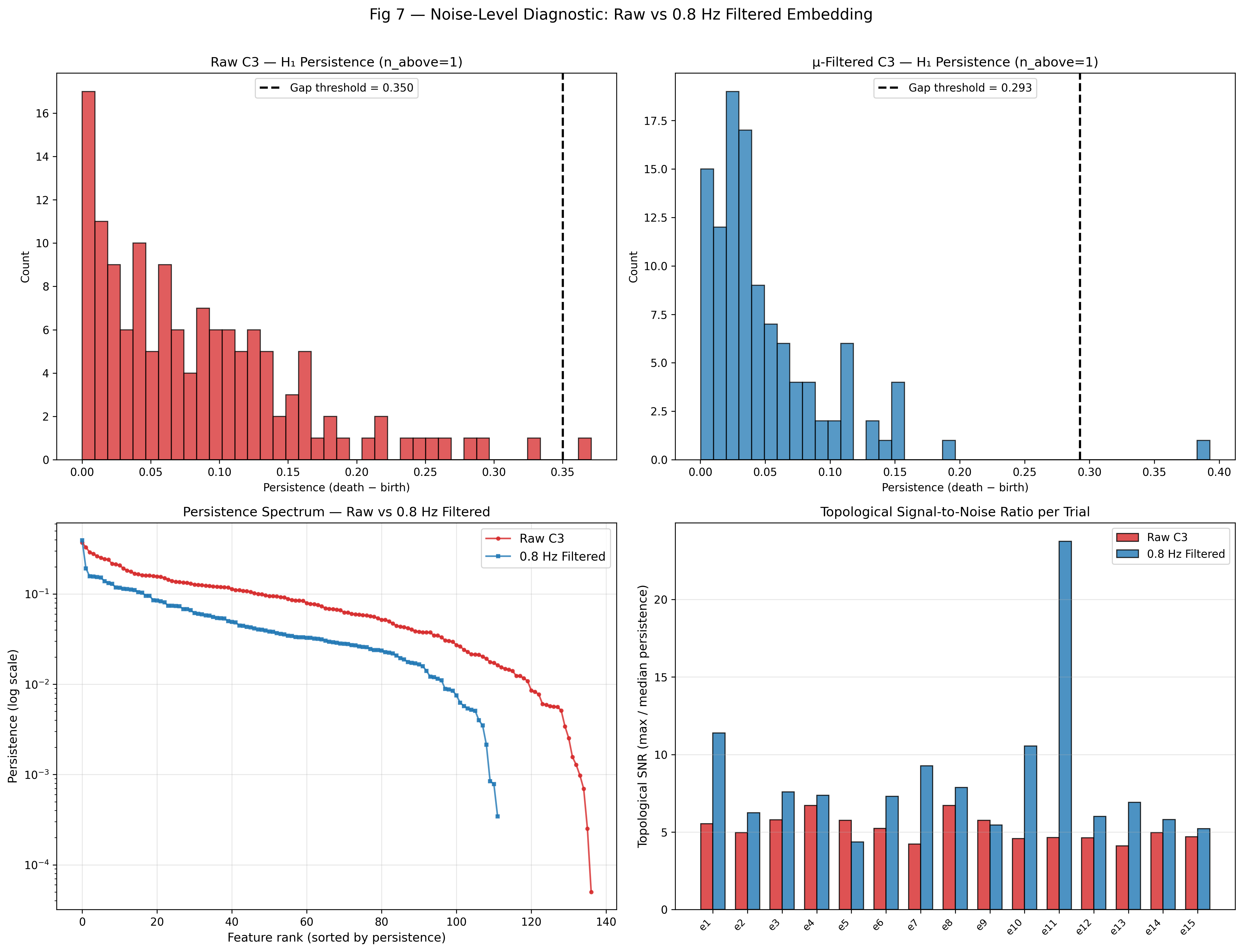
Raw and 0.8 Hz filtered embedding diagnostics
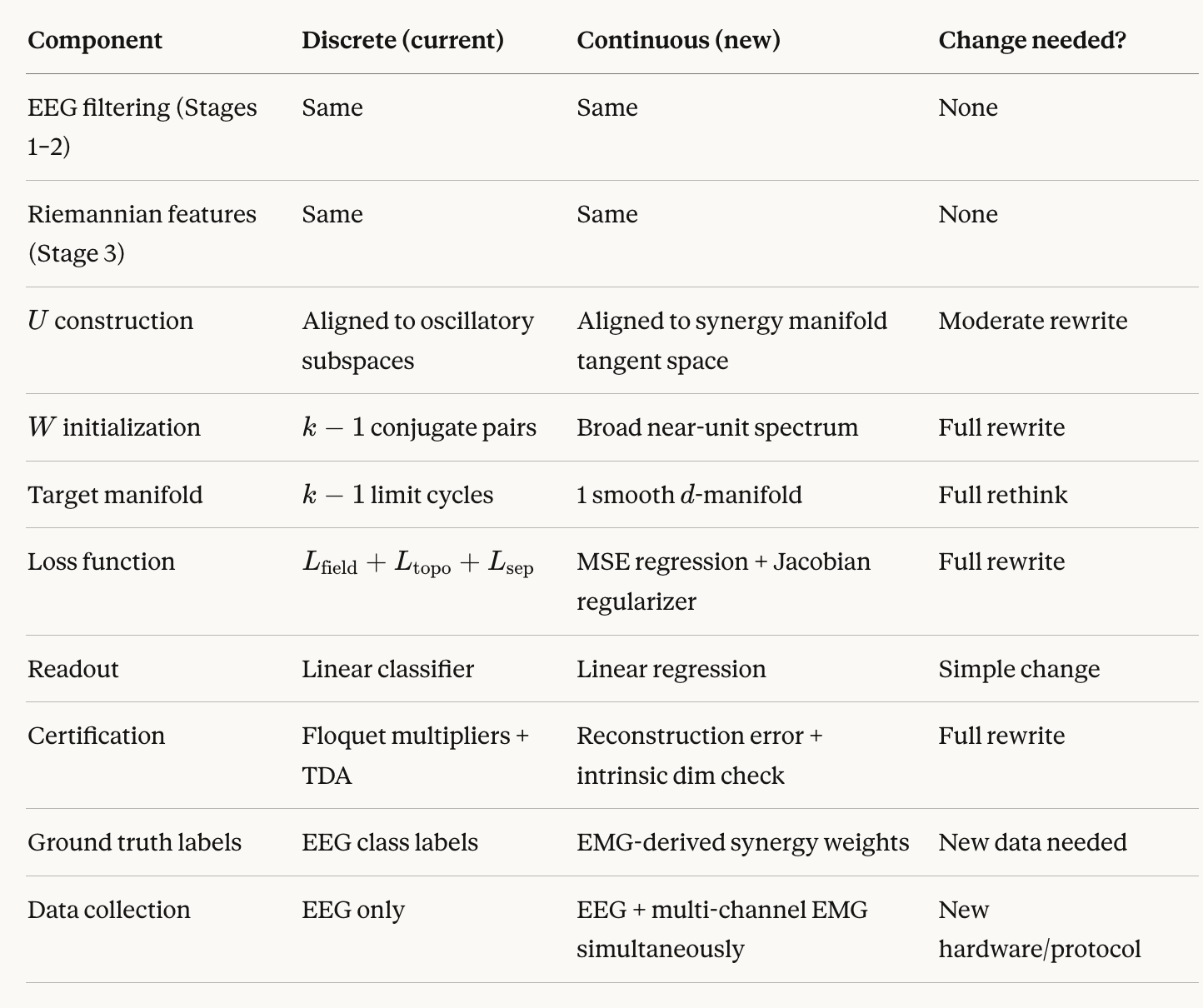
Discrete and continuous control design options
- review questions: does vectorization preserve the intended inner product; which reference covariance defines the log-map; are CCA/ridge parameters fitted inside the evaluation split; and how is phase mapped to joint coordinates? Recover source code/configuration rather than translating the prose directly into a performance claim.
- claims needing reconciliation: the primer contains broad assertions of noise immunity, rigorous equivalence to invasive performance and aggregate calibration-time arithmetic. Those are not adopted as verified facts here. Use its conceptual pipeline and glossary as navigation aids, while numerical claims require an identifiable dataset, protocol, model version and evaluation record.