EvolMoves: topology-proposal calibration
C = 36 from the one-SE rule, raw max was 144. ESS/iteration jump looks huge, ESS/hour much less dramatic... use the latter for compute planning.
- recorded calibration: fifteen proposal weights × three seeds = 45 points, each with 2,000 iterations, on disjoint calibration fixtures. The selected weight is
C=36, the smallest weight within one standard error of the highest mean;C=144is the raw maximum.
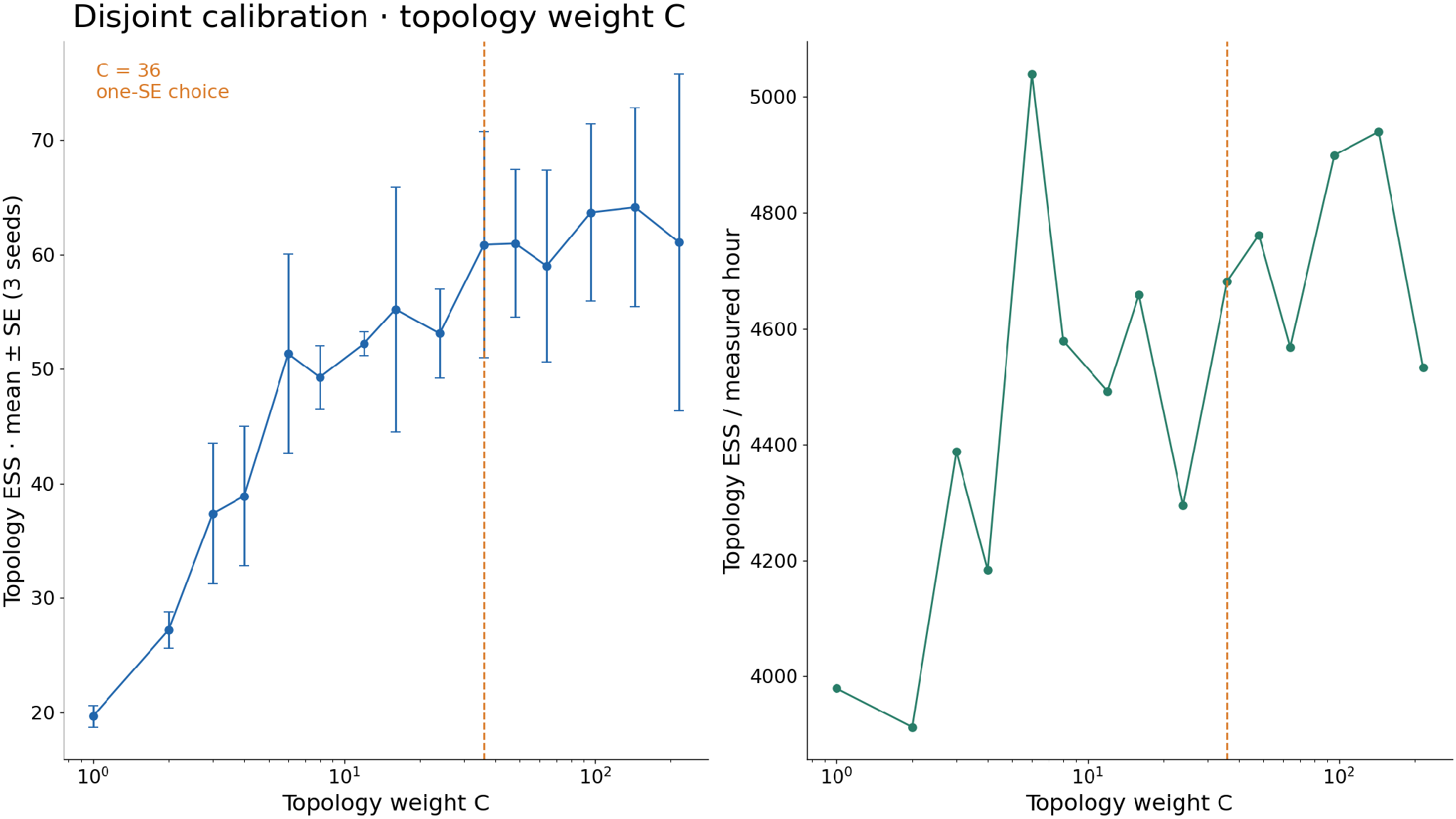
Topology-weight calibration and the selected C = 36.
- observed comparison in the deck: relative to
C=1, ESS increases about 209%, while ESS per hour increases only about 18%. More effective samples per fixed iteration budget is not the same as a proportional runtime speedup.
- artifact:
benchmarks/nute2019/config/weights.calibration.tsvat the deck'se2b603d5evidence cutoff.
- review questions: keep calibration fixtures disjoint from evaluation cases; identify exactly which trace supplies ESS; report per-seed variability and the selection rule. Confirm whether changing a proposal weight changes work per iteration before comparing iteration counts. This bounded calibration is not a general upstream performance claim.