THALis: multi-primitive loss and transition requirements
multiple primitives + rest + fast transitions, not just one nice stable cycle. wondering if faster switching makes the individual patterns harder to stabilize
problem statement from the open-problems document: active movements are intended to have cycle-like representations, rest a fixed-point representation, with separated attractor clouds and fast transitions. The written targets include transition latency below 125 samples/500 ms and greater than 80% held-out accuracy. These are targets in the problem statement, not results.
proposed loss: L_total = Σ L_field + lambda1*Σ L_topo + lambda2*L_sep. The terms respectively match target vector fields, compare persistence diagrams, and encourage geometric separation. Each term needs its own scale and an operational definition of the data used to compute it.
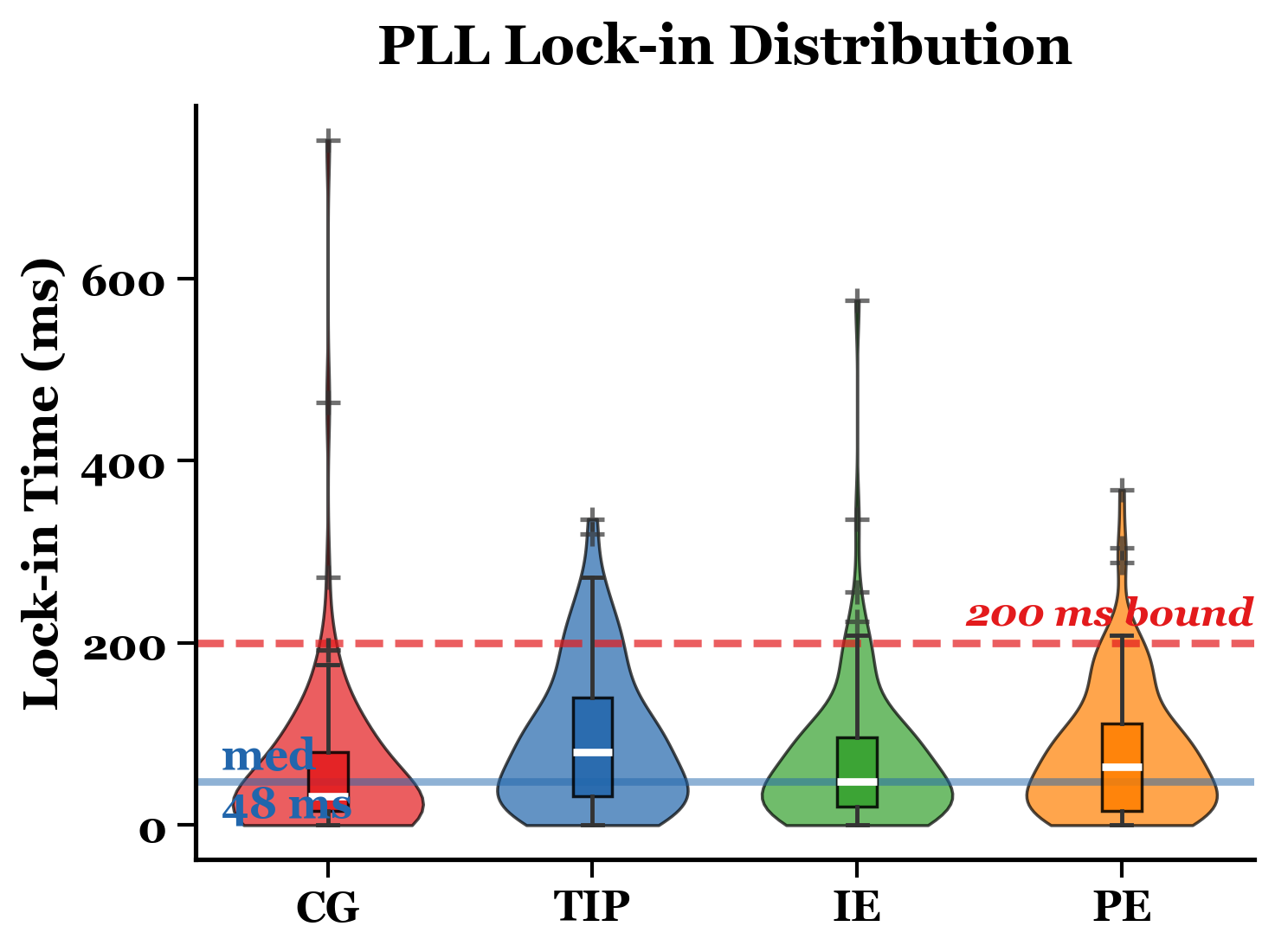
PLL lock-in time by movement
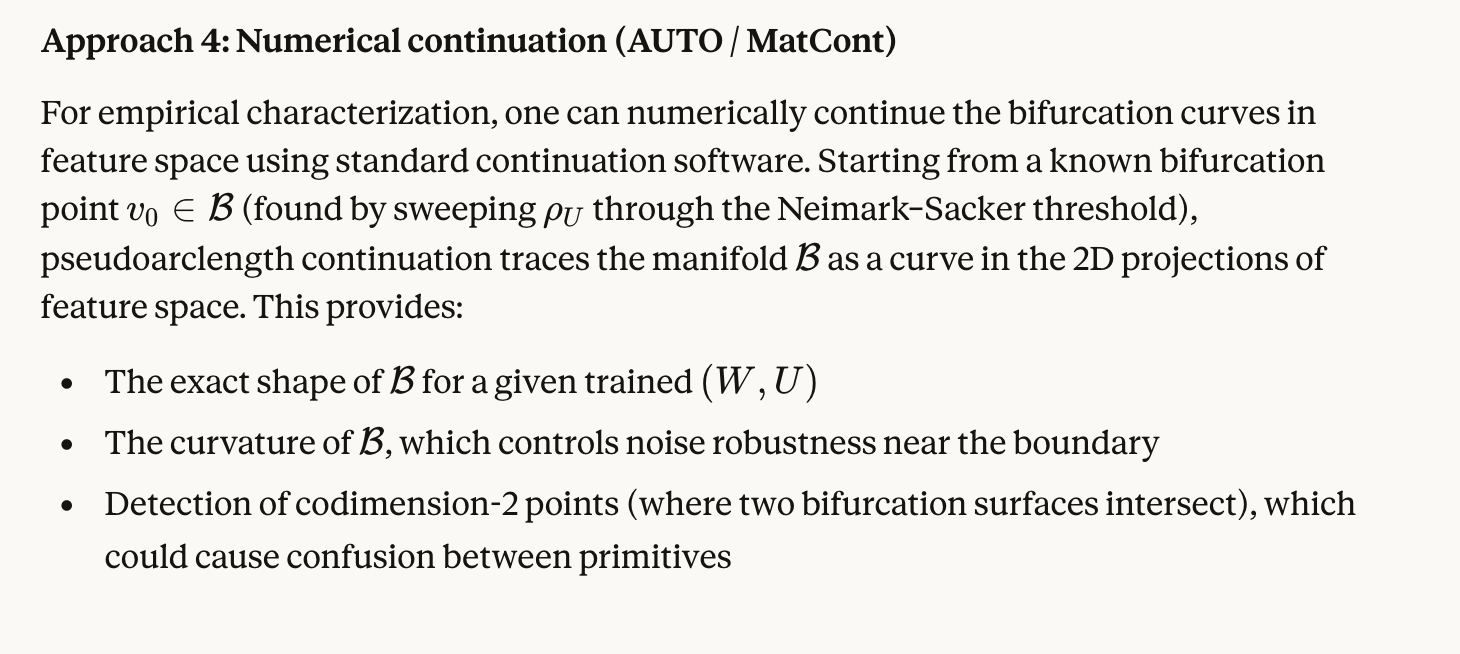
AUTO/MatCont continuation proposal
unresolved mathematical objectives: a bifurcation-boundary description, an adiabatic-tracking condition, transition-time bounds and a reservoir-size lower bound. These should stay in an open-problem index until a later document explicitly closes them with assumptions and proof.
- questions for implementation: does a cloud correspond to a frozen-input dynamical system, a driven trajectory, or an empirical task segment? What is the relation between the feature-update rate and the EEG sample rate? A latency written in raw samples may not equal the same number of reservoir/feature steps.