THALis: constructive reservoir-weight problem
can i build W and U around the feature geometry instead of hoping a random matrix behaves? keep the desired modes + input projection explicit, spectral radius alone isn't the full story
february open problem: given Riemannian feature trajectories for several motor primitives, construct recurrent weights W and input weights U that both stabilize the driven system and preserve useful movement structure. The feature construction is scalp EEG → band filtering → CSP → covariance → log-map vectorization, with Nfeat = p(p+1)/2 for a symmetric p×p covariance.
proposed input route: PCA bases for each primitive, a discriminative basis B from aggregated features, then U = rho_U * Q_res * B^T. The recurrent initialization proposes conjugate eigenvalue pairs near the unit circle, using r0 in (0.90, 0.98) and a more strongly contracting complement.
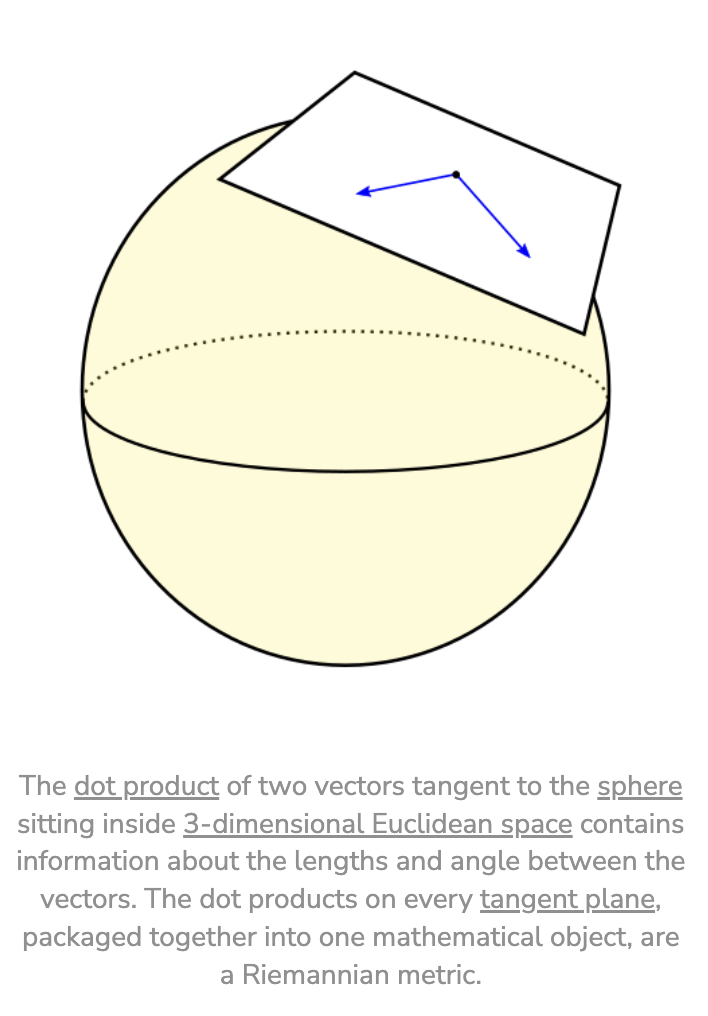
Riemannian manifold and tangent spaces

Optimization Algorithms on Matrix Manifolds
proposed separability quantity: minimum inter-primitive Riemannian distance divided by maximum within-primitive diameter. The document asks whether this ratio can characterize when a feasible input scale exists; this is a target theorem, not a demonstrated equivalence.
review flags: the draft says spectral radius below one ensures the echo-state property; later V2 material explicitly treats that shortcut as insufficient in general. Also, the need for input-driven contraction and the proposal for separate attracting movement cycles require a precise model/regime distinction. Preserve those tensions rather than copying the initialization as a certified design.
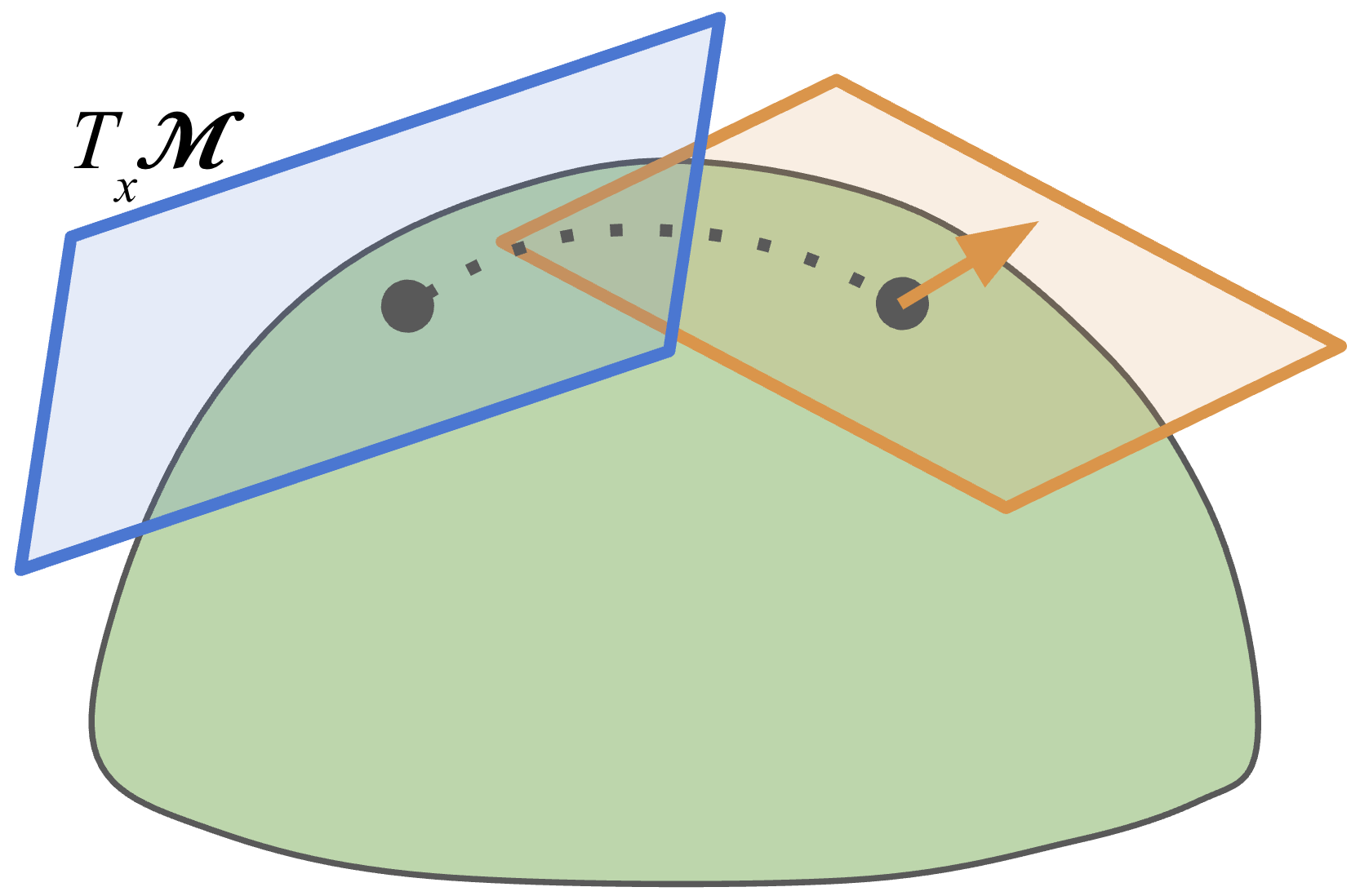
Tangent-space geometry