Bottleneck matching: proposed features and reconstruction loop
regression NOT classification — density / angle / position for matching in→out pieces
what if several candidates want the same exit? also try tracing the bottleneck backward, should the pairings agree?
The scratch note explicitly says “Regression NOT Classification.” Proposed association information includes fiber density/AFD or FBC, angular difference, spatial distance/location, and anatomical priors or partial-volume plausibility. It sketches representative input/output bundles formed by averaging and a score for each proposed pair. Treat this as a design note, not a trained-model specification.
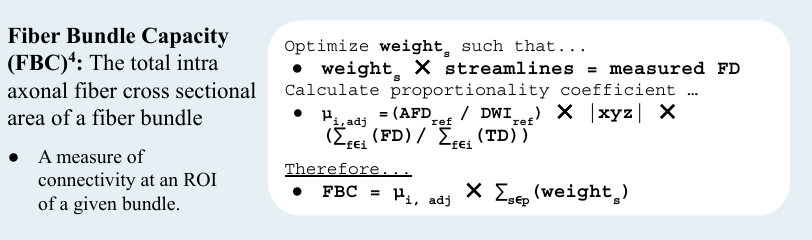
Fiber-bundle-capacity and normalization equations.
Working loop in the notes: identify the bottleneck, gather input/output candidates, score their associations, repeat matching until the threshold is met, then continue tractography. Questions to keep beside the design: what is averaged (positions, tangents, density or embeddings), how are candidate counts handled, can several inputs map to one output, and how is the stopping threshold calibrated? These are follow-up questions from reviewing the note, not dated historical decisions.
The later poster defines FBC using FBC = μ_adj * sum(streamline weights) and describes weights chosen so streamline contributions match measured fiber density. Its proportionality expression also includes reference AFD/DWI, voxel volume and FD/TD sums. Recover exact normalization and dimensional units from implementation before translating that compact poster equation into code. The saved reference is Quantitative streamlines tractography.