ReconBench: empirical parameter extraction
start from cleaned families, keep filter counts alongside the params. Especially the class imbalance — don't let the tiny SCOP groups disappear into one pooled histogram.
Source pipeline: Pfam v36 seed alignments and associated FastTree trees, grouped by unambiguous SCOP class. The report gives 6,712 families: 6,363 Type 1, 151 Type 2, 119 Type 3 and 79 Type 4. It describes exclusion of singleton families, sequences shorter than ten residues, nonstandard amino-acid codes and duplicates, plus uppercasing.
extract_params.py: ModelTest-NG estimates substitution-model choice, amino-acid frequencies, gamma shape, invariant-site proportion and fit statistics. The workflow also records indel/gap-run summaries and tree-shape quantities including normalized Colless imbalance.
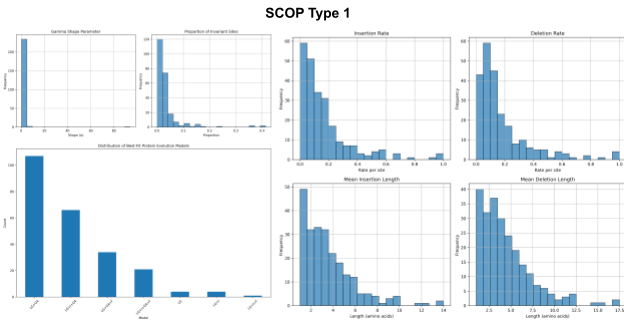
Empirical substitution models, indel rates, and indel lengths.
Important provenance boundary: the report's entropy-based fallback estimates and approximate insertion-length calculation are for visualization/characterization only, not inputs to the fitted distributions. Preserve that distinction in exported tables.
Review questions: what exclusion count accompanies each filter, how are duplicates across families handled, and do discarded ambiguous SCOP mappings change the class distribution? Recover tool versions from manifests—the report still contains vX.X placeholders for some tools.
References retained in the report: ModelTest-NG, Pfam.