
Historian: segmentation faults and partial-trace handling
SIGSEGV followed by “trace parsed successfully”... seriously 🙃. process status and parser status need separate fields, partial output can still look completely readable.
september 2–3 runtime log: SCOPt3 and SCOPt1 Historian processes terminate with SIGSEGV: 11; other runs hit the seven-hour ceiling. The wrapper then prints “trace parsed successfully” after some failures. Successful parsing therefore cannot be used as the completed-run flag.
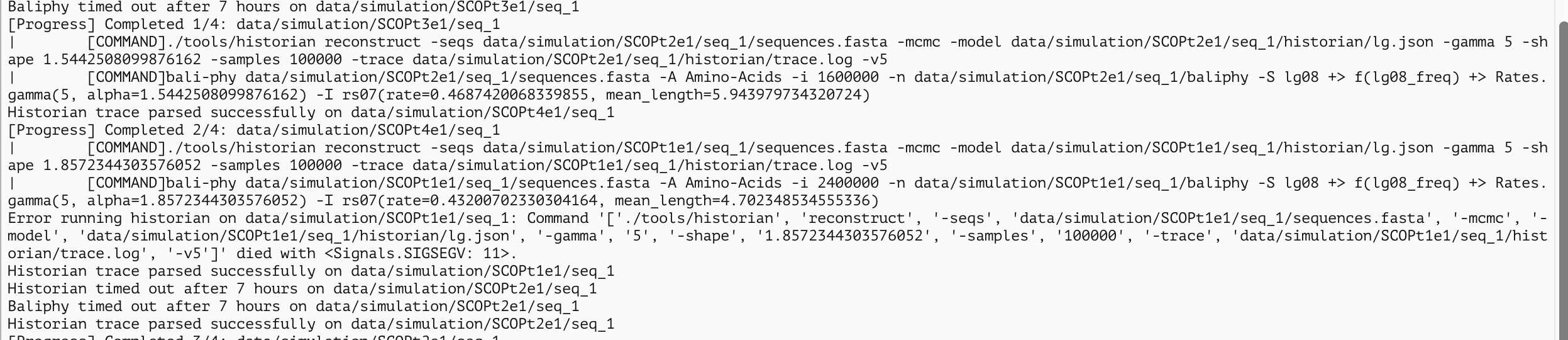
Historian SIGSEGV followed by the wrapper’s successful-parsing message.
historical code pointers: the interrupted September 3 traceback names src/main_simulation.py, runBenchmark, and the concurrent.futures.as_completed loop at line 493 in that snapshot. Line numbers are historical traceback locations, not stable links in the current repository.
- review checks: save exit status, timeout reason, last successful sample, number of retained samples and parser status separately. A crash may leave syntactically valid partial output; scientific scoring needs an explicit missing/partial-run policy.
- diagnostic boundary: the folder is labeled “Historian Memory Issue,” but the terminal trace alone does not identify the cause of the segmentation fault. Do not assert a memory leak or a fixed bug without a reproducer/backtrace.
- command context: Historian uses
reconstruct,-mcmc, model JSON, five gamma categories,-samples 100000,-traceand-v5in these runs.