ReconBench: empirical parameters, synthetic truth
biological params → synthetic cases w/ known history → reconstruction tests. Keep the dependencies between params, random plausible values individually could still make a very weird family together.
Benchmark problem: using an already inferred alignment/tree as unquestioned truth can inherit the assumptions of the earlier inference tool. ReconBench instead fits evolutionary-parameter distributions from biological protein-family data, generates new trees, and simulates sequences with known generative records.
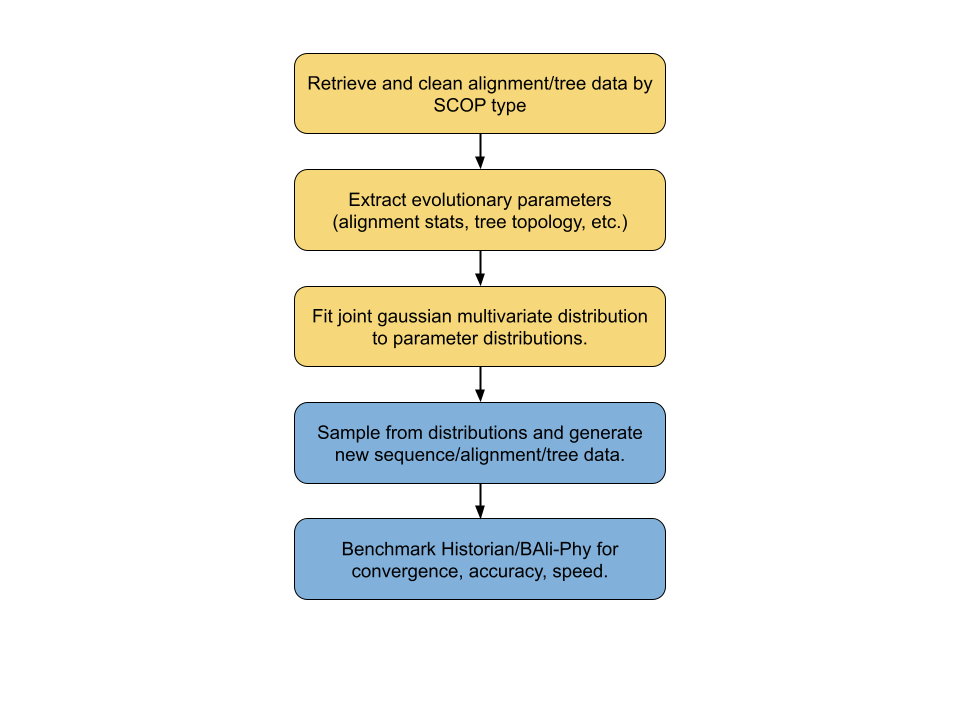
ReconBench: empirical data to synthetic cases and tool evaluation.
Pipeline documented in the 2025 report: Pfam/SCOP cleaning → extract_params.py → modelfit.py → tree_gen_bd.py → INDELible → Historian/BAli-Phy runners → trace parsing and accuracy/convergence metrics. The later report expands the retrospective summary; it should not be mistaken for a day-by-day July/August diary.
Core choices: joint parameter sampling to retain dependencies; birth–death model strata; normalized Colless imbalance and Pybus–Harvey gamma as tree-shape targets; simulated annealing to refine a generated tree; separate true alignment/tree artifacts for scoring.
Repositories: framework, 2025 evaluation branch, Historian modifications.
Review questions: how much does fitting from inferred biological inputs still influence the synthetic distribution? Report robustness to model mismatch and biological benchmarks separately. Synthetic truth improves identifiability of the test; it does not make the simulation a complete model of biology.