MesoNet: experiment protocol and robustness definition
350 ms on, 150 ms settling—keep the rest of the schedule beside it. split / frozen weights / what “robustness” means all need to line up
Later paper's stated protocol: static image presentation for 350 ms, followed by 150 ms to allow state to settle; one pass through a training portion described as 70%, frozen weights for the remaining 30%. The text also gives approximately 50,000 iterations for MNIST and refers elsewhere to accuracy across epochs, so recover the exact split and schedule rather than assuming those phrases are identical.
Architecture: split inputs across convolutional branches such as 3×3, 5×5 and 7×7, then merge. This is intended to support multiple spatial scales. The source points to NMCtests for preliminary designs, not a single pinned final configuration.

Experiment constants
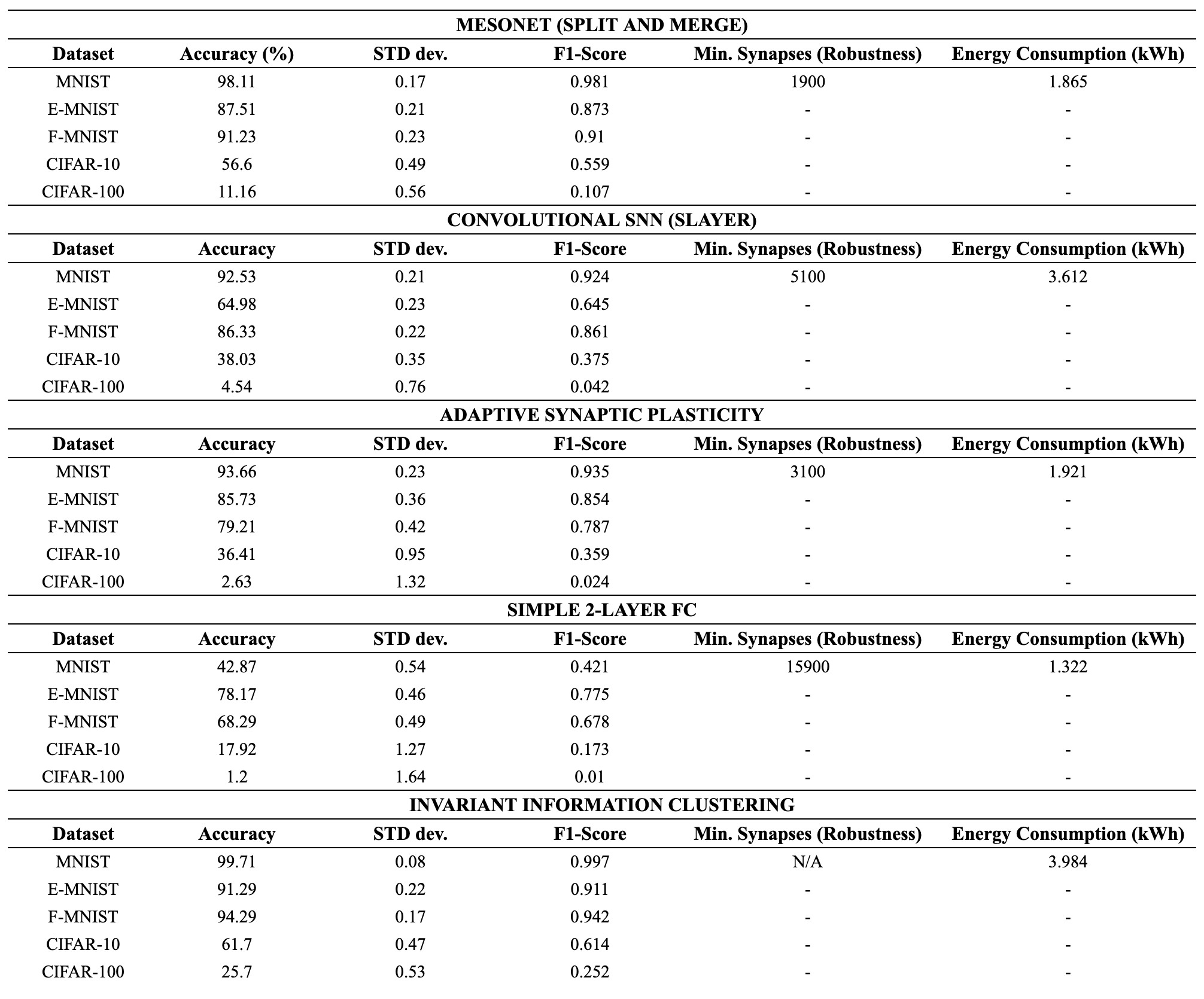
Benchmark result tables
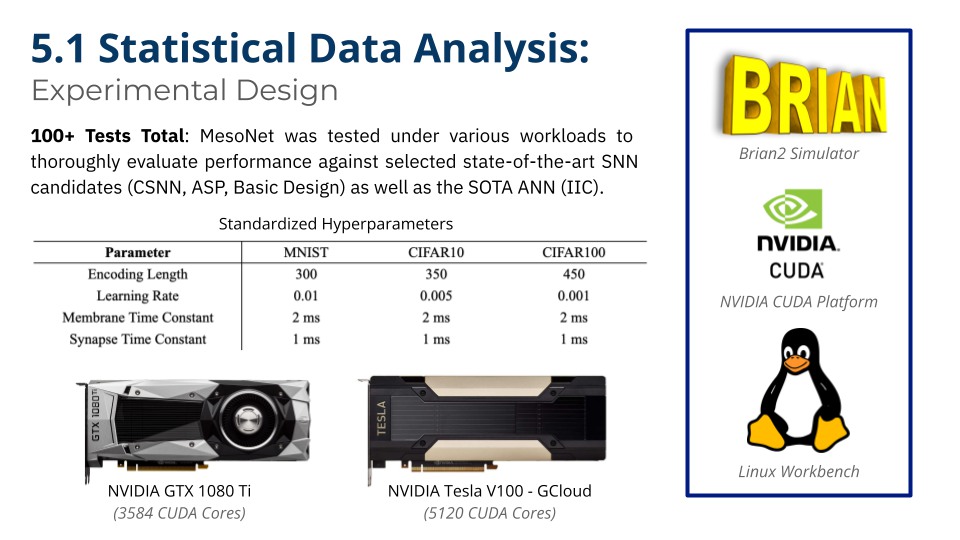
Experiment design and hardware
Robustness definition: maximum number of neurons or synapses removed before accuracy decreases by 5%. Clarify whether “5%” is relative or percentage points, how components are selected for removal, and whether any retraining occurs. Counts without the original network size cannot be compared as removal fractions.
Review questions: are all models evaluated with comparable readout label access, runtime budget and stopping criteria? Does “energy” mean hardware energy, an estimator or operation counts? Store those definitions with the results rather than relying on poster wording.