THALis: initial topological-analysis pipeline
window → delay cloud → persistence diagram, lots of knobs in between. keep delay / dimension / filtration / scale with the output or i'll just have a folder of mysterious plots
archive (eb1afda): tda.py adds delay-coordinate embedding, persistent homology, Betti-number analysis and bottleneck-distance comparisons. Initial outputs are named m1_pipeline_data.npz and m1_pipeline_results.png.
analysis objects: a time-series window becomes a point cloud via an embedding; a filtration produces persistence intervals; diagrams and distances summarize features across scales. Each transformation introduces parameters that must travel with the plot.
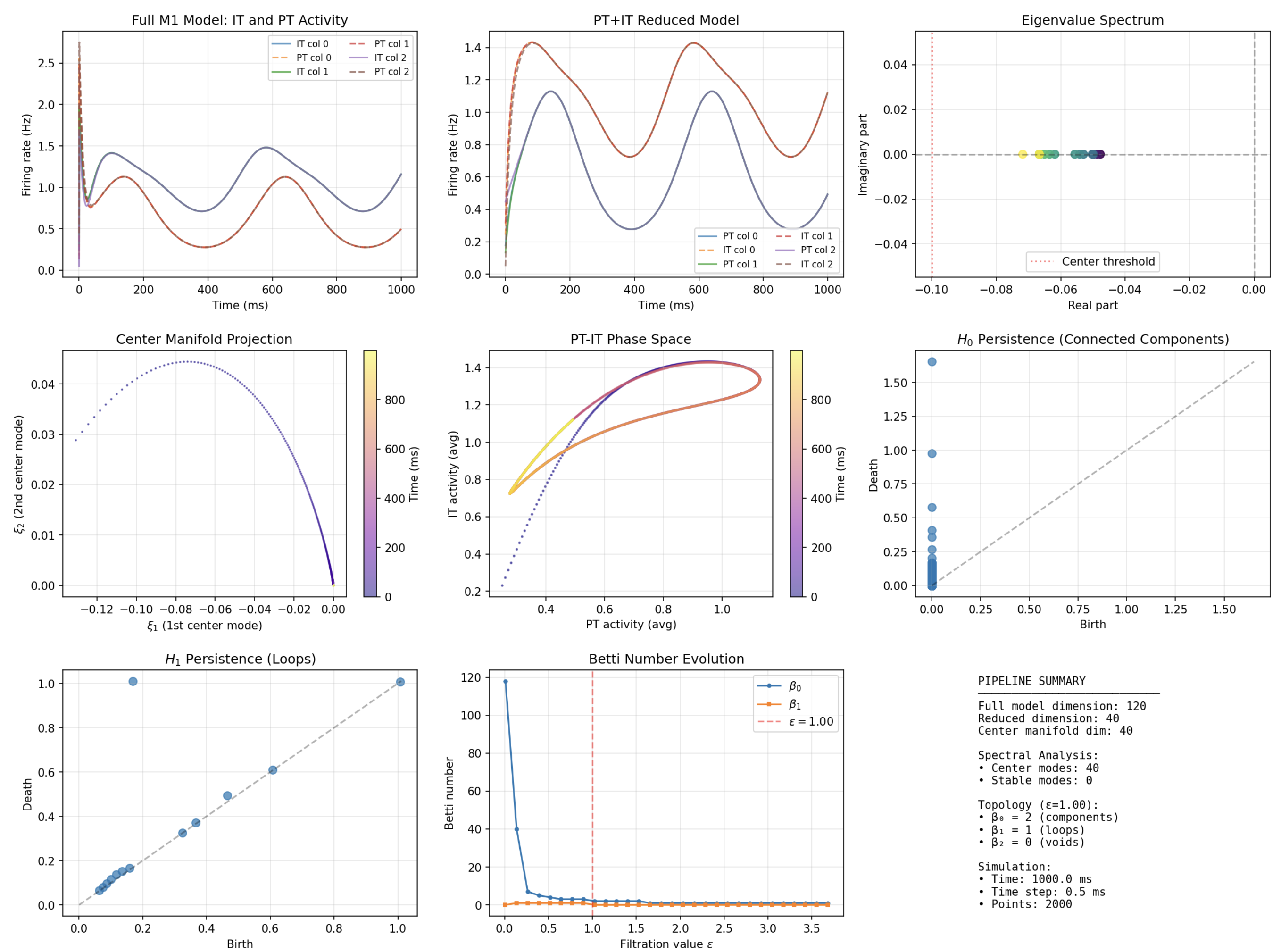
120-dimensional model and 40-dimensional reduction
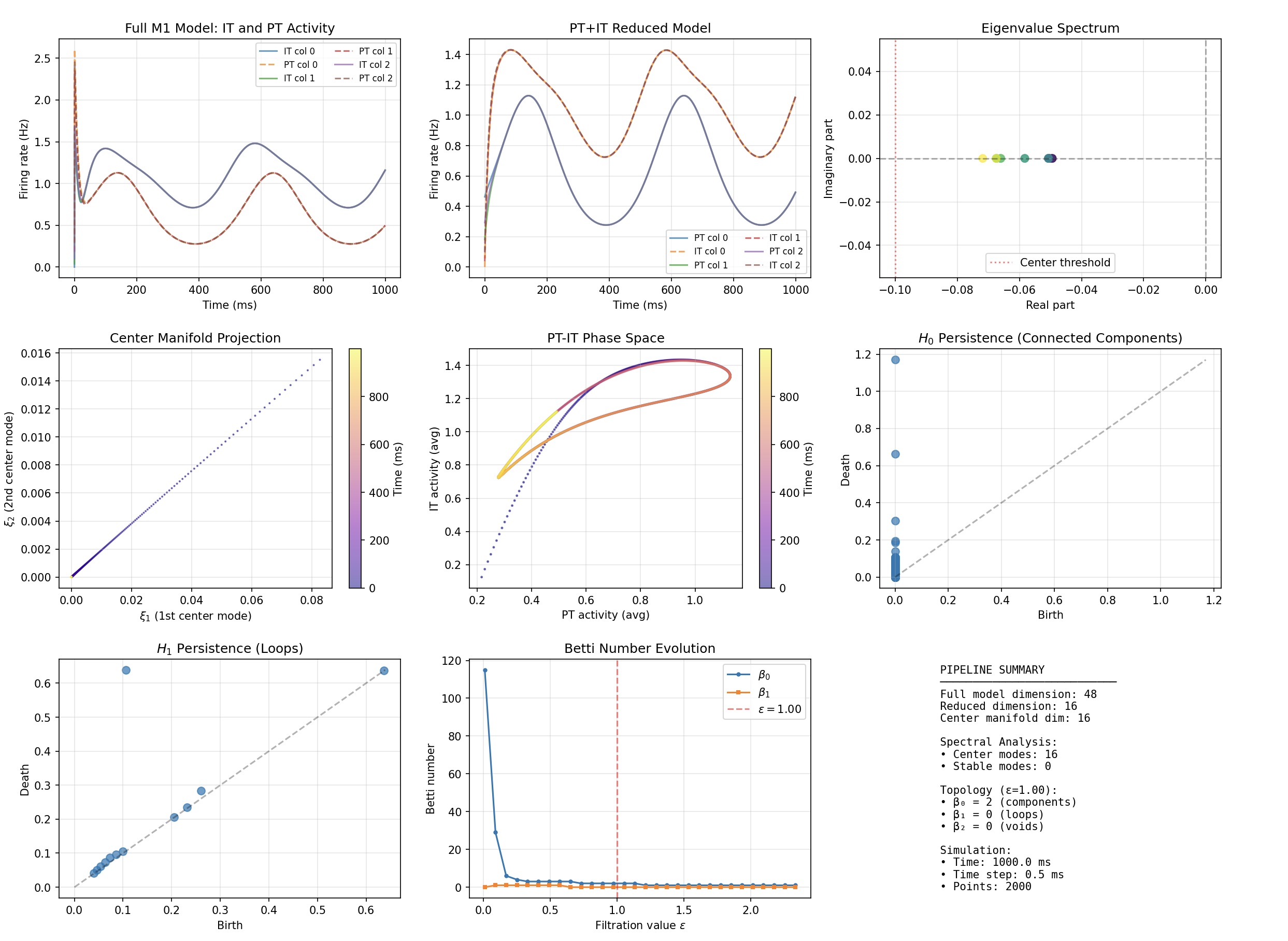
48-dimensional model and 16-dimensional reduction
run settings to recover: source channels/features, preprocessing, embedding delay/dimension, window length/stride, distance metric, filtration convention and homology degrees. The archive identifies capabilities but does not supply all these values in the commit summary.
review questions: is a condition difference robust to preprocessing and sampling, or caused by cloud scale/density? How are uncertainty and null comparisons assessed? A visually different persistence diagram is an exploratory result, not automatically evidence that the latent motor system is reconstructed faithfully.
archived code references: eb1afda.