EvolDeeds: likelihood, mixing and user credit
high likelihood but chain stuck in one spot... not really the win to reward. Need credit for exploration too; revisit ESS + clade summaries before deciding what the score should mean.
working distinction: a high joint log-likelihood and good posterior exploration are different objectives. The brainstorm proposes scoring sampled alignment/tree/history states while separately examining MCMC mixing; Krishna is named on ESS/MCT work.
inputs to scoring: alignment, tree, ancestral history and the model/parameters used to generate or evaluate that state. The example calcscore.js consumes an evolutionary-model JSON, Newick tree and FASTA input. Keep the complete state and model identity with its score.
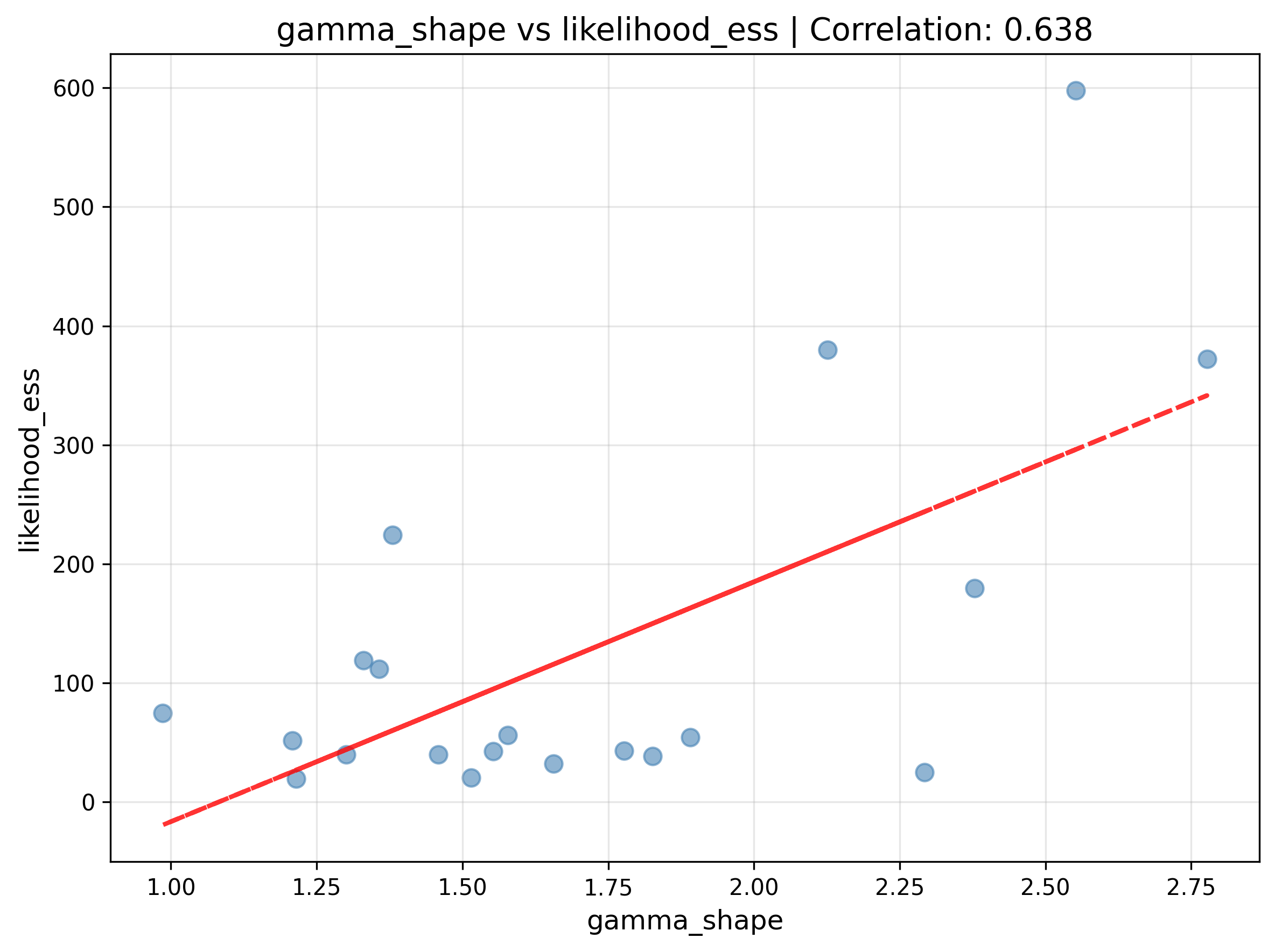
Historian: gamma shape versus likelihood ess.
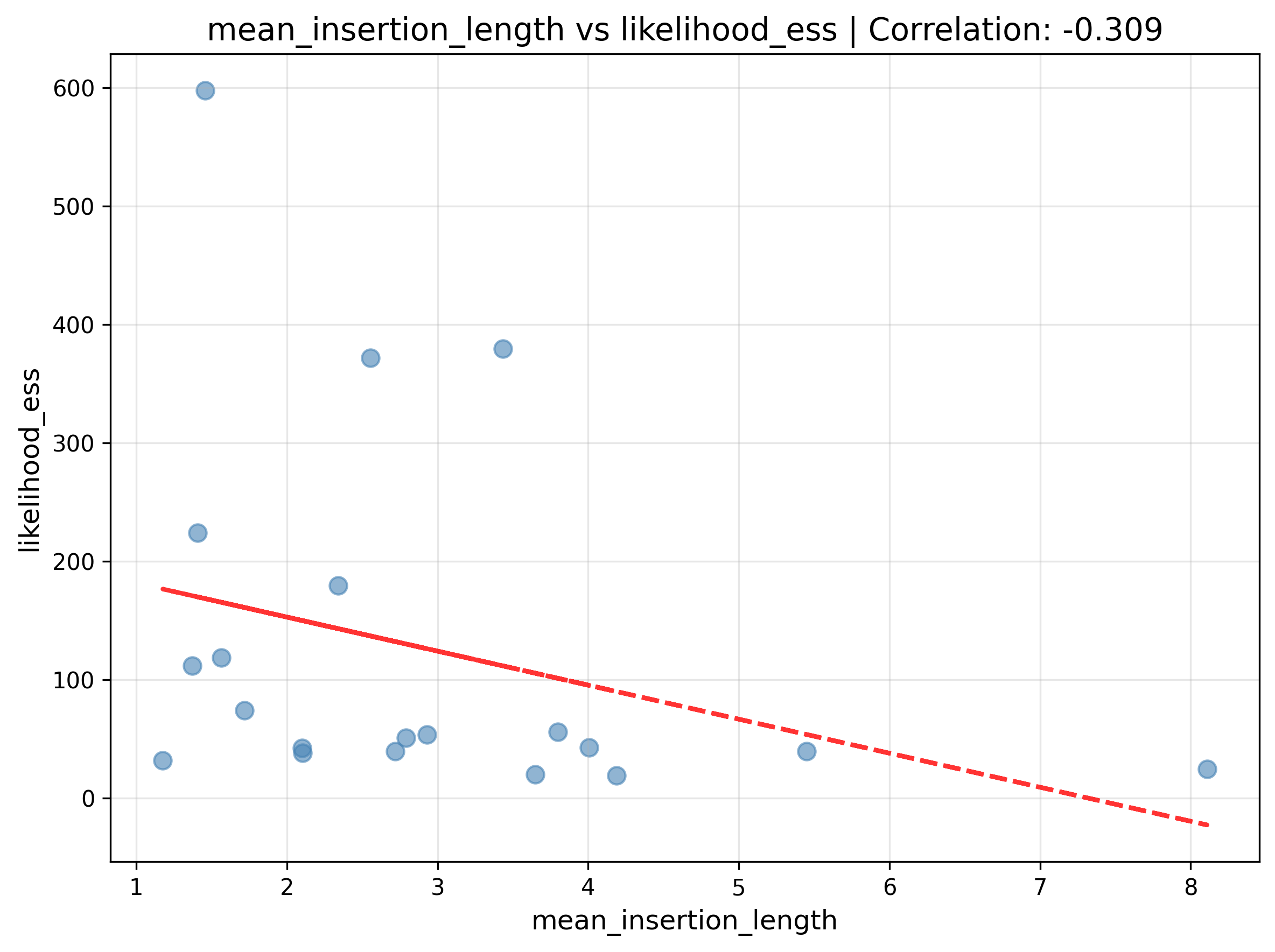
Historian: mean insertion length versus likelihood ess.
ideas in the source: award credit for exploration rather than only the single highest score; visualize uncertainty on branches/columns; consider conditional-clade-distribution summaries rather than relying only on one representative tree. MCMC exploration paper; conditional-clade-distribution reference.
- review questions: which scalar trace is used for ESS, and does it represent alignment/topology behavior? How are repeated states and burn-in handled? A score-based leaderboard should not be presented as evidence that independent chains explored the same posterior modes.