MesoNet: incidence weighting and shortest paths
functional distance → paths → share credit. 1/w needs care w/ zero or signed weights; also if two routes tie, split credit or just take whichever the search finds first?
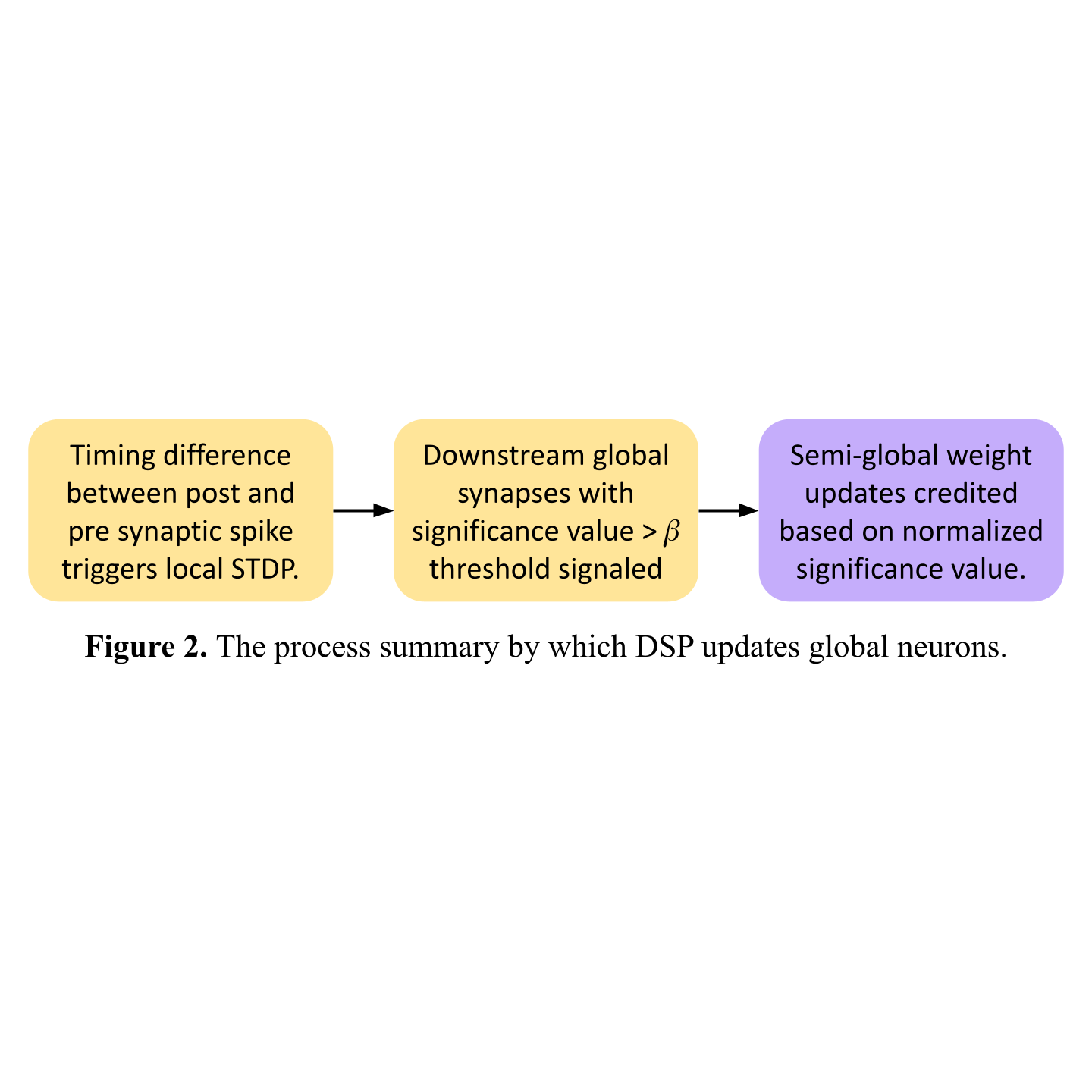
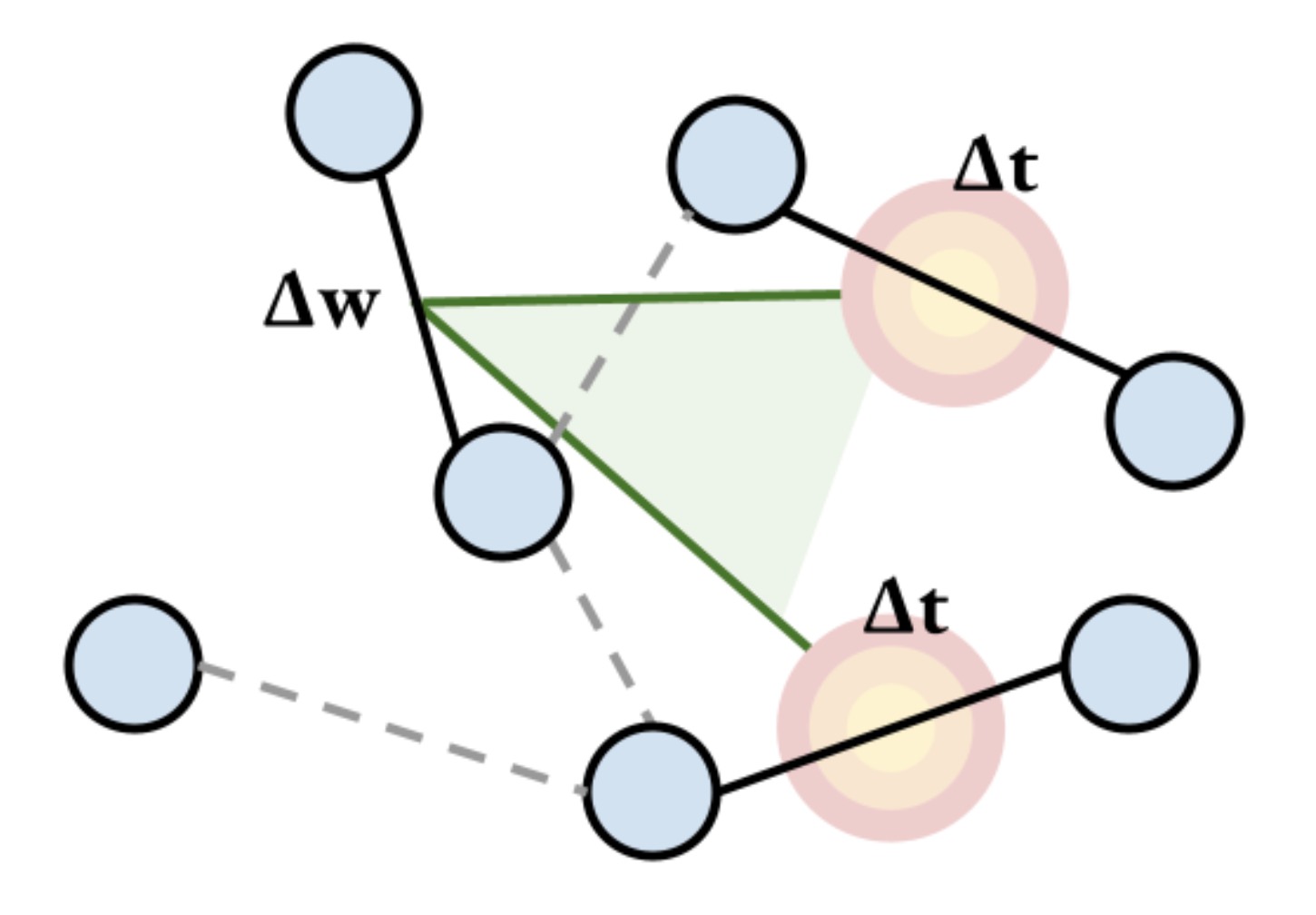
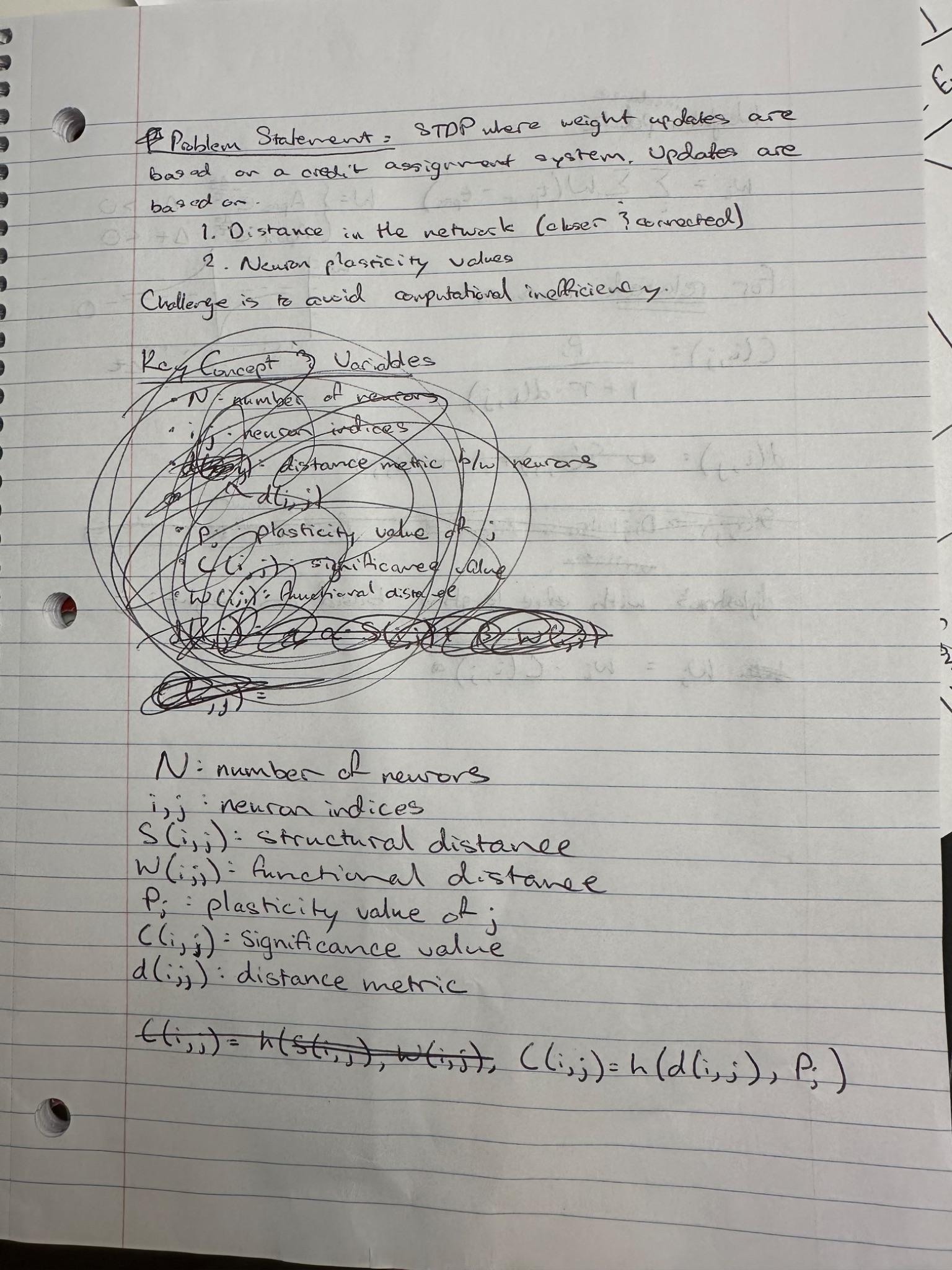
proposal: distribute an STDP update to surrounding significant neurons using a functional distance on the synaptic graph. The notebook suggests edge cost 1/w, a Dijkstra-like shortest-path calculation, and an incidence score increasing with plasticity and decreasing with distance.
candidate weighting forms: weighted multiplicative combination, exponential distance decay, additive inverse-distance weighting and logarithmic normalization. Recipient selection is unresolved: probabilistic sampling versus a deterministic choice such as top-k.
failure mode explicitly noted: plasticity affects update allocation; receiving an update increases plasticity; that can reinforce the same recipients indefinitely.
Local STDP and distributed updates
Triangulated attribution
References saved in this journal section
- https://www.pinecone.io/learn/series/faiss/locality-sensitive-hashing/
- https://adrianmejia.com/how-to-find-time-complexity-of-an-algorithm-code-big-o-notation/
- https://www.frontiersin.org/journals/computational-neuroscience/articles/10.3389/fncom.2023.1215824/full
- https://www.geeksforgeeks.org/minimum-number-of-edges-between-two-vertices-of-a-graph/
- https://www.baeldung.com/cs/shortest-path-to-nodes-graph
- review questions: how are zero or negative weights handled before applying inverse-weight distance? Are edge costs guaranteed nonnegative for the chosen search? How often must distances be recomputed as weights change? Which normalization prevents total propagated update magnitude from growing with recipient count? These are implementation questions, not a proof of the mechanism's stability.

Equations and response sketches
Graph-attribution working notes

Attribution and weighting notes