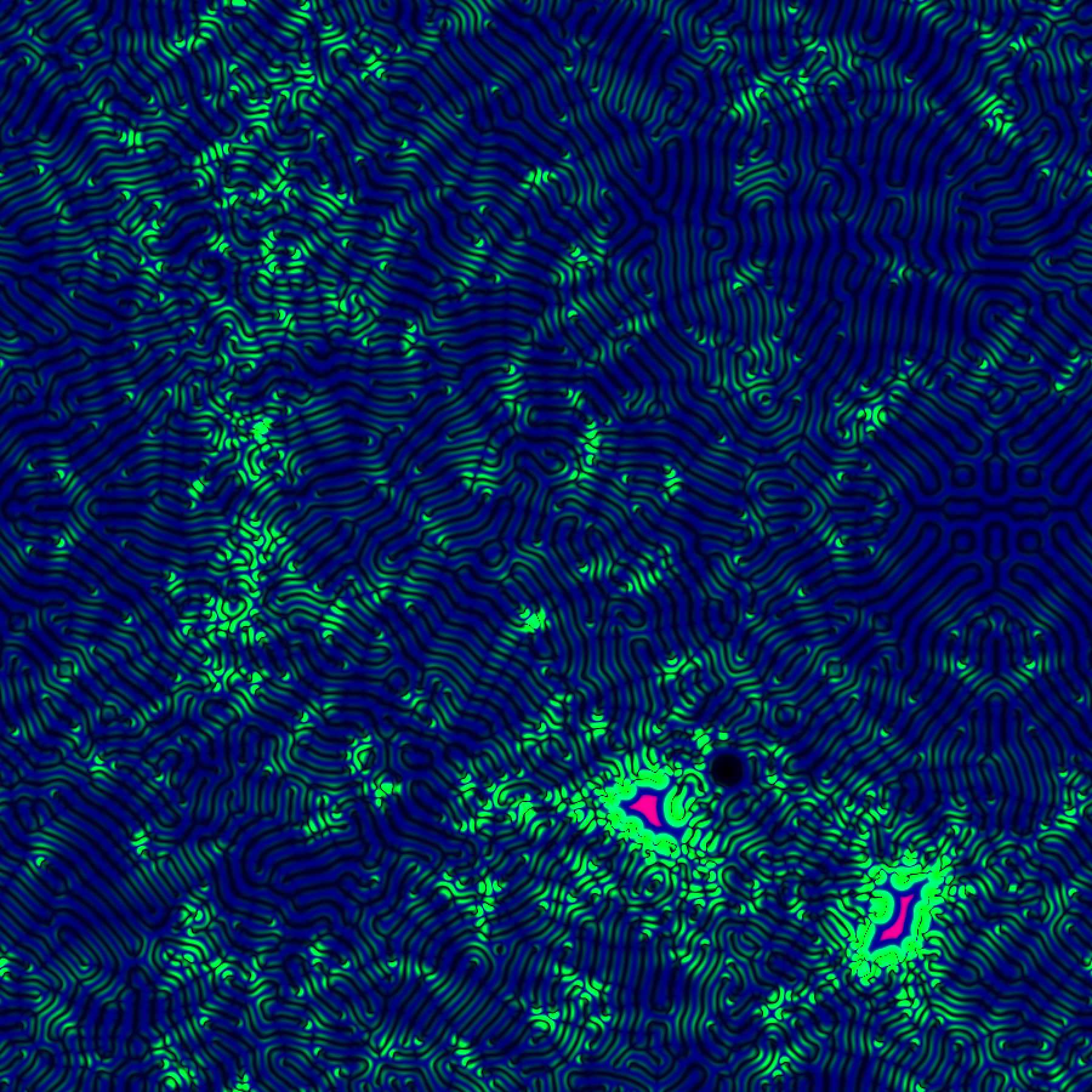
MesoNet: training diagnostics
log firing rates + weight histories too. accuracy alone tells me basically nothing about which layer is going quiet or blowing up
- recorded work: layer-wise STDP training on MNIST; activity-dependent learning-rate changes; global inhibition and homeostatic scaling experiments; wrapper logging expanded beyond classification output.
- signals to retain: neuron activation frequency, weight distributions/evolution, stability indicators and runtime. The journal also mentions energy tracking, but does not identify a measurement method in this dated entry.
- metric distinction: spike/event counts can be computational proxies; they are not interchangeable with measured joules. Likewise, unsupervised representation quality and a label-trained readout's accuracy answer different questions.
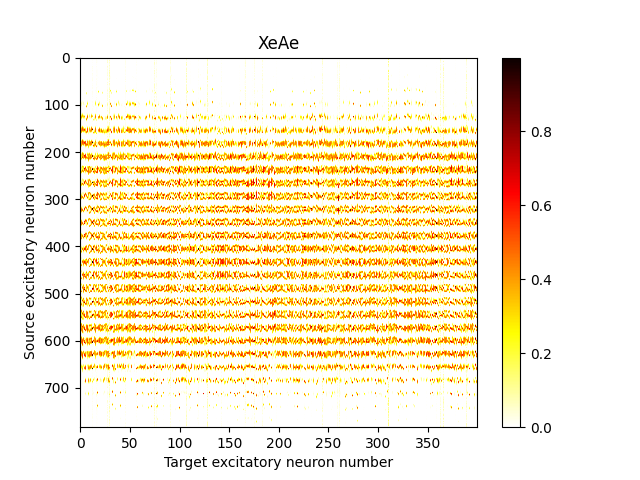
XeAe input-to-excitatory weight matrix

Iterative development
- review questions: does the recorder capture per-layer silent neurons, saturated weights and oscillations? Keep diagnostic overhead visible when comparing speed. A network may appear stable simply because activity has collapsed, so inspect firing and weights together.
- References saved in this journal section
- https://brian2.readthedocs.io/en/2.6.0/reference/brian2.core.network.Network.html
- https://brian2.readthedocs.io/en/2.7.1/reference/brian2.input.spikegeneratorgroup.SpikeGeneratorGroup.html
- https://www.frontiersin.org/journals/neuroinformatics/articles/10.3389/fninf.2022.883700/full
- https://github.com/brian-team/brian2cuda/issues/46
- https://brian2cuda.readthedocs.io/en/latest/reference/brian2cuda.__init__.example_run.html