MesoNet: baseline equations and run configuration
equations + constants here so i stop hunting for them. don't skip the reset / refractory / inhibitory paths just bc the learning rule is more interesting
Neuron equation recorded in the reference sheet:
tau*dV/dt = (e_rest - V) + g_e*(e_exc - V) + g_i*(e_inh - V)
V > v_thresh  ->  V = v_reset, then refractory interval
tau_ge*dg_e/dt = -g_e
tau_gi*dg_i/dt = -g_i
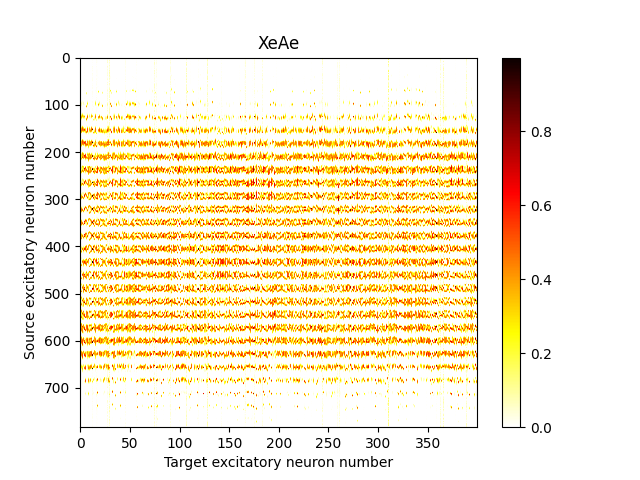
Presynaptic events increment conductance by the synaptic weight. The input layer contains 28×28 pixel neurons. A variable-size excitatory population is paired one-to-one with an equally sized inhibitory population; the notes record an inhibitory-to-excitatory maximum conductance of 10 nS.
Input encoding: present an image for 350 ms using Poisson spikes; pixel intensity divided by four gives a maximum base rate of 63.75 Hz. If fewer than five excitatory spikes occur in that interval, the recorded rule increases maximum input firing rate by 32 Hz.
Learning sketch: delta_w = learn_r * (x_pre - x_tar) * (w_max - w)^m; presynaptic trace increases on a presynaptic spike. The sheet explicitly leaves trace-decay and threshold-adaptation decay equations to be completed—do not treat it as a complete implementation.
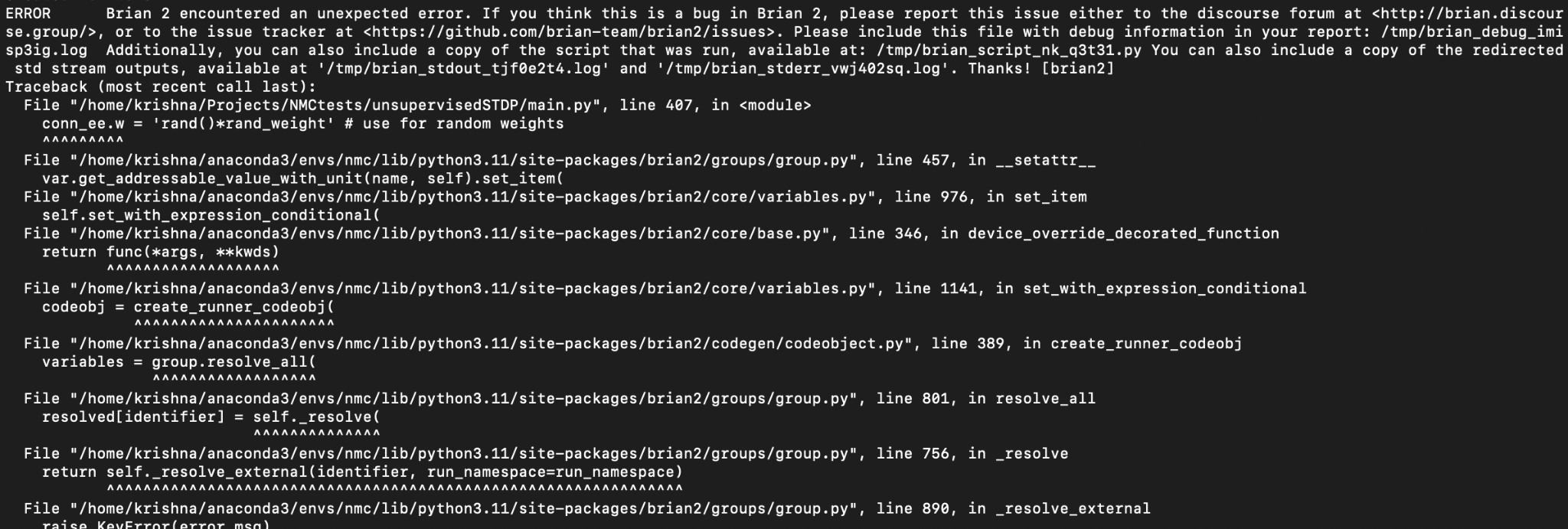
Run issues: initialization and save-directory failures; temporary use of reference weights; overnight job terminated with the remote session. The notes point to nohup as a persistence option. Keep the initialization workaround recorded when comparing runs.
References saved in this journal section
- https://github.com/GenevieveF/Diehl-Cook_2015_Brian2/blob/main/README.md
- https://www.reddit.com/r/pytorch/comments/p6296v/can_anyone_send_a_zip_download_link_for_the_mnist/
- https://www.digitalocean.com/community/tutorials/nohup-command-in-linux)
- https://yann.lecun.com/exdb/mnist/
- https://www.kaggle.com/datasets/avnishnish/mnist-original
XeAe input-to-excitatory weight matrix
Baseline simulation console

Baseline runtime output