TractX model recipe and what remains needed to reproduce it
poster recipe: 3 conv, 2 ReLU, flatten, 2 dense; lr 0.001 / 128 epochs / L2
missing widths, batch size, L2 coeff + exact loss path. save the checkpoint/log next to the diagram if found
The poster supplies more concrete model details than the journal summary: concatenate the region data; apply three convolution layers, two ReLU activations, flatten, two dense layers, then output a vector representation. It lists learning rate 0.001, 128 epochs and L2 regularization. Augmentation is described as noise injection and resizing masks; inputs are synthetic HCP-derived examples segmented around bottlenecks. Record these as the poster's recipe, not an independently rerun configuration.
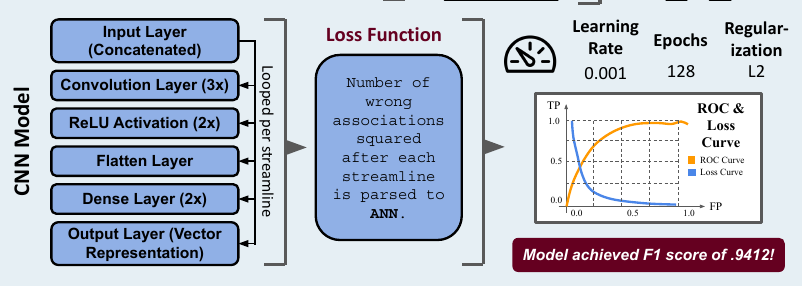
CNN layers, loss, training settings and poster-reported F1.
Its loss is described as the squared number of wrong associations after parsing each streamline through the nearest-neighbor system. The downstream approximate-neighbor section describes LSH buckets and lower-dimensional projections, with MRtrix3, RecoBundlesX, PyTorch, FAISS and DIPY named as development APIs. Missing reproducibility details include convolution widths/kernels, optimizer, L2 coefficient, batch size, exact loss implementation/gradient path, augmentation magnitude, data split and ANN index parameters.
- The poster reports model F1 0.9412, approximately 14 hours for the complete pipeline on an M1 machine, and optimization for 1 mm images. These are separate model/pipeline measurements and should not be conflated. Retrieve the training log/checkpoint and per-stage timing before making a speed or generalization comparison.
- The archived
Github.pdfcontains blizzard-labs/tractx-no-maps. This scan verifies the saved repository pointer, not its present code contents or any code-line references.