TDA manuscript: exact fixed-two-bar deficit
fixed two-bar case, actually enumerate the source + diagonal options. ties count with multiplicity; don't lose one just because the costs happen to match
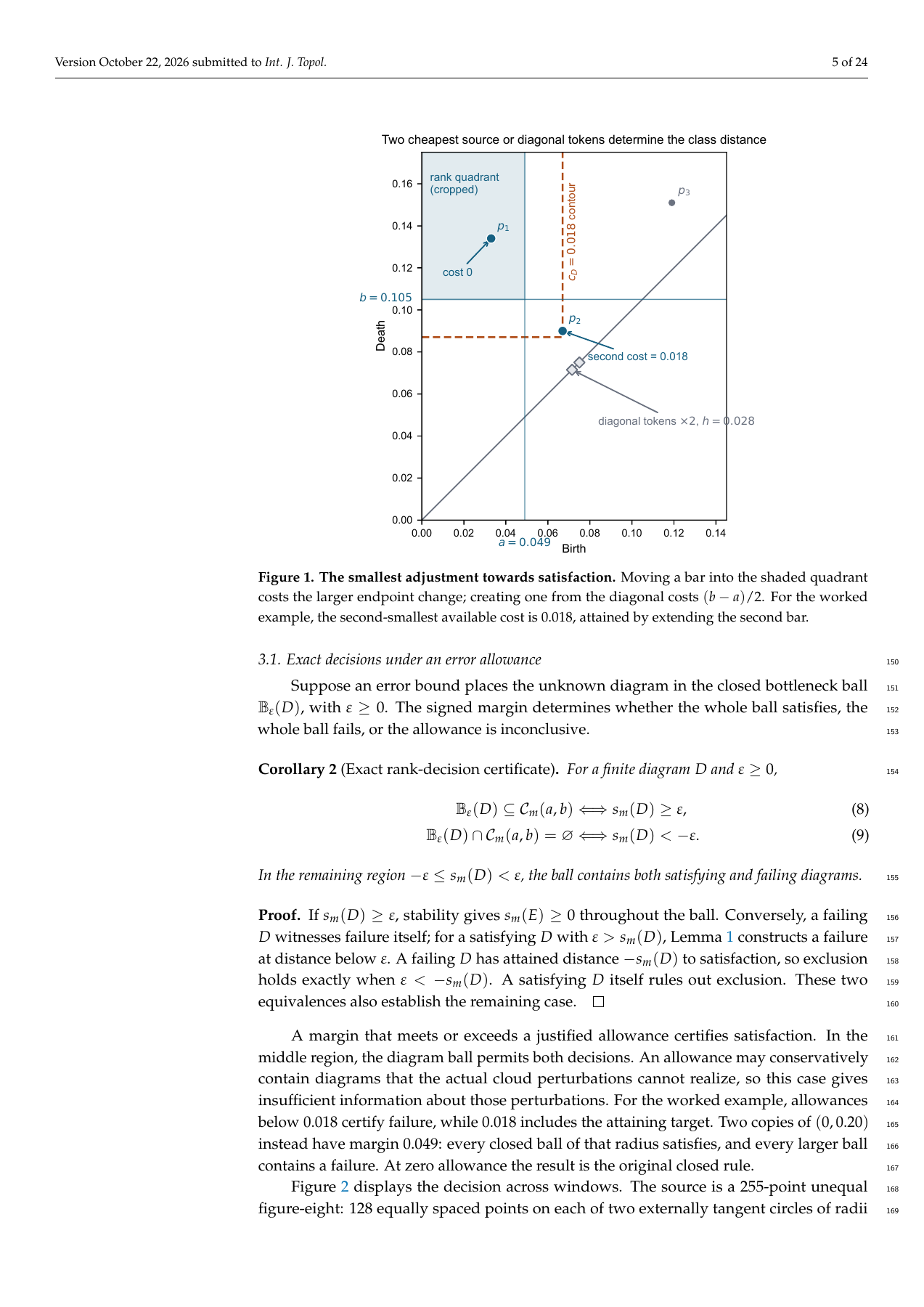
Worked window in Supplement S2: a=0.049, b=0.105, midpoint c=0.077, half-width h=0.028. The target class consists of diagrams with at least two bar occurrences satisfying closed inequalities u≤a and v≥b.
Projection price for bar (u,v): pi(u,v)=max(max(u-a,0), max(b-v,0)). Add two diagonal-creation prices h,h; the second-smallest entry, counted with multiplicity, gives the fixed-two-bar deficit. Equivalently the supplement states d2(D)=max(h-lambda_2^D(c),0), using the second persistence-landscape value at the midpoint.
Fixed-two-bar matching example
Attaining construction: move each selected existing bar to (min(u,a), max(v,b)); for a selected diagonal price add a new (a,b) bar; leave other bars unchanged. Duplicate occurrences count separately.
Boundary caution: the closed death inequality differs from a strict half-open-barcode event. The supplement notes equal distance functions but warns that zero distance does not imply the strict event. Preserve this distinction in code/tests.
File pointer: m2-eval/fixed-m2-evaluator-extract.tex, as named in the supplement. Review cases: fewer than two bars, duplicate bars, bars exactly on each boundary and empty diagrams. These are reference checks, not newly executed tests.