NeuroReach: remote camera and missing-evidence semantics
lost arm tracking ≠ arm stayed still, ugh this needs an explicit state. Check frame age all the way through WebRTC. Save for later: small camera-confidence indicator instead of making someone watch a skeleton overlay?
target path: browser getUserMedia → WebRTC track → Python aiortc receiver → MediaPipe Pose/Hands → kinematic features → fusion. Electron's LAN server brokers signaling. The roadmap marks real WebRTC integration as next-stage and describes existing signaling as an echo stub.
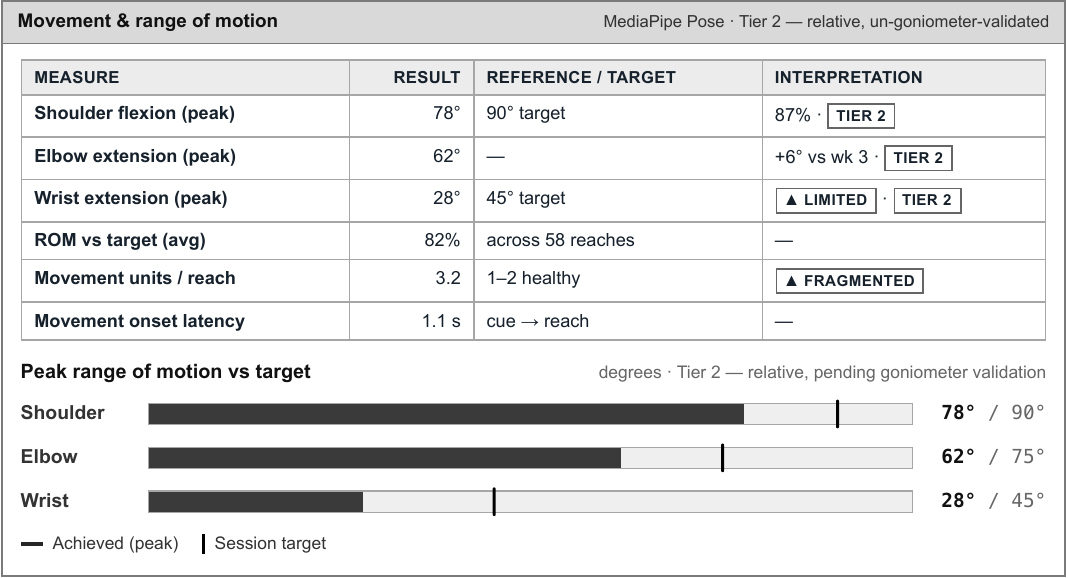
Sample report: relative camera-based movement estimates.
feature plan: joint angles from landmark triplets, trunk displacement relative to a five-second seated-rest capture, and movement velocity/smoothness. Affected-side configuration mirrors landmark selection. RGB-only tracking means camera placement and visibility are part of the measurement setup.
critical rule: missing or stale pose is absent evidence, not evidence of stillness. An occluded arm or dropped frame must not silently validate a covert-imagery trial. Track landmark confidence and frame age; either decay last-known-good state, omit affected contributions, or visibly enter a defined degraded mode.
open design issue: the spec permits EEG-only use when camera permission is denied, while also using camera verification to establish covert-trial validity. The resulting validity label must distinguish “not observed” from “observed still.”
- review questions: where is capture-time information retained across video encoding/transport? Can frame-age limits be tested with injected jitter and packet loss? What ground-truth measurement validates the angle output? These questions are compiled from the proposed pipeline, not completed experiment results.